 Historical Figure MBTI
#639 · 5-11-26 · The Julio-Claudians
Antonia Minor
Antony's Daughter · The Letter That Warned an Emperor
36 BCE — 37 CE
6 min read
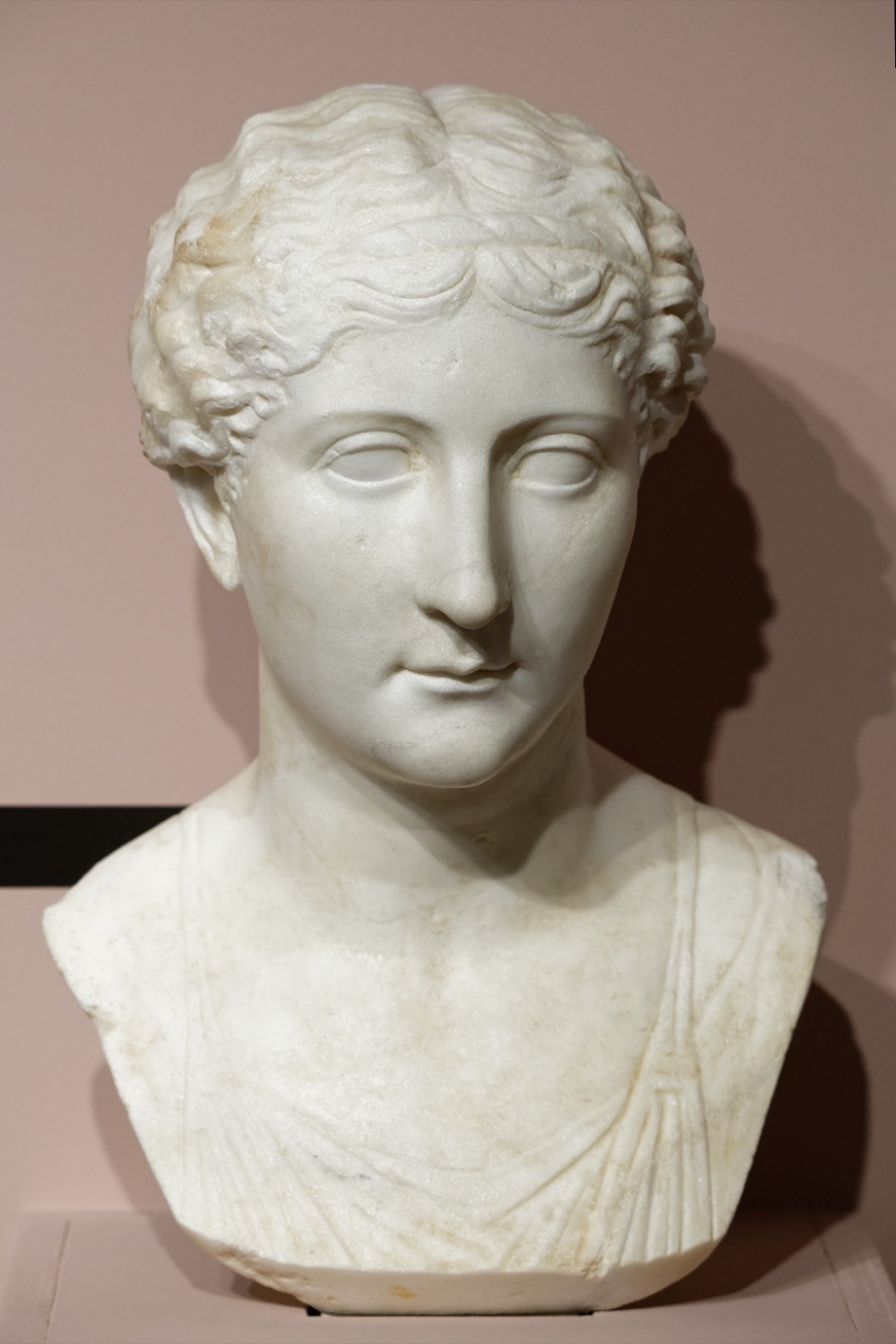
Portrait of Antonia Minor
The Household That Held the Line
Antonia Minor spent most of her ninety-odd years being underestimated, which suited her. Daughter of Mark Antony and Octavia Minor, niece of Augustus, she was married off young to Drusus the Elder, widowed in her twenties, and then — remarkably, for a woman prized on the marriage market of a dynasty-obsessed empire — simply declined to remarry. For the next four decades she ran a household of legendary strictness, raising Germanicus, Livilla, and Claudius, holding herself to a standard of propriety so rigid it became its own kind of fame. She was, by every account, unimpeachable, unglamorous, and easy to overlook.
Then, in 31 CE, she wrote a letter. Having pieced together evidence of Sejanus's conspiracy against Tiberius — implicating, by most reconstructions, her own daughter Livilla as accomplice in poisoning her son-in-law Drusus the Younger — she sent word directly to the emperor on Capri. Ancient sources credit that single letter with triggering Tiberius's swift, total destruction of Sejanus. It was the one public act of a woman who had spent her life declining public acts.
That combination — decades of unbroken domestic discipline punctuated by one devastating intervention — is the signature of an ISTJ. Antonia's power was never theatrical. It was procedural, private, and cumulative, built out of an internal ledger of duty and precedent that she enforced without exception — on her household, on her children, and, when the moment finally demanded it, on the empire itself.
Antonia Minor was not a woman who watched from the margins. She was a woman who kept the ledger — and settled it, once, all at once.
The Widow Who Refused to Move On
After Drusus the Elder's death, Antonia was, by every practical measure, a woman worth remarrying — young, well-connected, still fertile, and sitting at the exact junction of Rome's two great families. She refused, and kept refusing, for the rest of her life. That refusal was not romantic sentiment so much as a decision about which role she owed her fidelity to: widow, mother, and keeper of an established house, rather than pawn in a fresh alliance. Once she had settled on the correct course, she did not revisit it.
The same fixedness showed in how she ran her household. Ancient writers remembered her less for warmth than for order — an exacting manager of property, staff, and behavior, someone who measured her children against a known standard and did not soften the verdict when they fell short. Her open disdain for Claudius's stammer and physical infirmities reads, to modern eyes, as harsh; to Antonia it was simply an honest accounting against a precedent she trusted absolutely, the same precedent by which she judged everything else.
This is Si operating exactly as it should in an ISTJ: not nostalgia, but a stored, internalized standard of how a Roman household, a Roman widow, and a Roman mother ought to conduct themselves — applied consistently, for decades, without needing to be re-litigated each time.
The Letter to Capri
When Antonia acted, she acted with total decisiveness and no visible hesitation. Piecing together the evidence of Sejanus's conspiracy — almost certainly gathered through her own household's network of freedmen and informants, the same apparatus she used to run her domestic affairs — she did not wait to deliberate publicly, seek allies, or float the accusation gradually. She wrote directly to Tiberius, the one recipient who could act on it, and let the facts do the rest. The letter is remembered by ancient historians as the single trigger for Tiberius's abrupt, comprehensive purge of Sejanus and his faction.
The same efficient ruthlessness appears in what she is said to have done afterward: having her own daughter Livilla walled up and starved to death for her part in the conspiracy and in the poisoning of Drusus the Younger. Whatever grief attended that decision, the execution of it was swift, private, and final — a household matter handled with the same managerial finality she brought to everything else.
This is auxiliary Te: results-oriented action, deployed sparingly but with complete authority once the internal Si standard has been violated. Antonia did not spend her life issuing commands. She spent it storing judgment, and when the moment came, she executed it without flinching.
What Rome Was Owed
Beneath the procedural coldness was a private moral code, held with real intensity even if rarely voiced. Antonia's judgment of Claudius was not political calculation — it cost her nothing to be kinder to a son who would, decades later, become emperor — it was an unbargained-with internal conviction about what a member of this family owed to its name. The same conviction, turned against her own daughter, produced the starkest act of her life: Livilla's death was not ordered by the state but, by tradition, carried out within the family, by the mother, as a matter of personal honor rather than public sentence.
That is tertiary Fi in an ISTJ: quieter and less visible than the Si-Te partnership that ran her daily life, but capable of overriding even maternal affection when her internal standard of loyalty to Rome and to the family's honor was violated beyond repair.
Why ISTJ Over ESTJ
Why not ESTJ?
An ESTJ reading would cast Antonia as an outward-facing administrator, running her household as a visible, socially performed operation — the Roman matron as public executive. But almost nothing about her authority was performed. She built it in private, over decades, through habit and precedent rather than open command, and she surfaced into decisive action exactly once, when the system she was loyal to was directly threatened. That pattern — years of quiet Si-anchored fidelity to order, breaking into Te action only under real pressure — is ISTJ, not the steady, outward assertiveness of an ESTJ.
The distinction matters because it explains the shape of her fame. An ESTJ Antonia would have been a known political operator in her own lifetime, visible in the machinery of the court. The actual Antonia was famous for the opposite — for restraint, for staying out of view — right up until the one moment the record couldn't ignore.
Connected Figures
Further Reading
- The Twelve Caesars — SuetoniusPrimary source on Antonia's household, her judgment of Claudius, and the Sejanus letter.
- The Annals — TacitusCorroborating political context for the fall of Sejanus and the Julio-Claudian court.
- Antonia Augusta: Portrait of a Great Roman Lady — Nikos KokkinosThe dedicated modern biography, reconstructing her life from fragmentary sources.
- Caligula: The Corruption of Power — Anthony BarrettTraces her role in the family through her grandson's reign to her death in 37 CE.
