 Historical Figure MBTI
#898 · 7-1-26 · The American Civil War
Mary Edwards Walker
Surgeon · Only Woman to Receive the Medal of Honor
1832 — 1919
8 min read
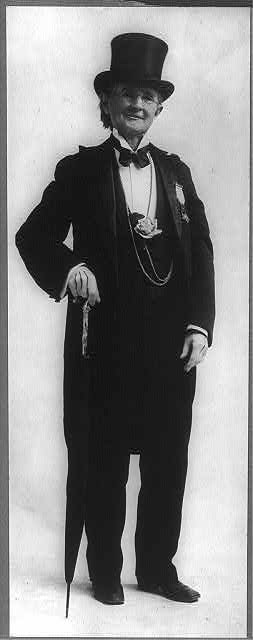
Portrait of Mary Edwards Walker
The Surgeon the Army Refused to Commission
In the spring of 1861, a twenty-nine-year-old physician with a degree from Syracuse Medical College presented herself to the Union Army and asked to serve as a surgeon. She was turned away — not for lack of skill, but for lack of a body the institution recognized as capable of holding that rank. Mary Edwards Walker did not appeal, and she did not wait for the rules to change. She went to the front anyway, unpaid, uncommissioned, dressed in a modified officer's uniform of her own design, and she operated on the wounded at Bull Run and Fredericksburg and Chattanooga until, in 1863, the Army relented and gave her a contract surgeon's post — one of the first ever held by a woman in United States military history.
That sequence — vision, refusal, action, eventual capitulation by the institution rather than by her — is the whole shape of Walker's life compressed into two years. It repeats itself in her captivity by Confederate forces in 1864, in her decades of public advocacy for dress reform, and in her flat refusal, at seventy-nine, to surrender the Medal of Honor the government tried to reclaim from her. She is best read as an ENTJ: a woman who built a private, unwavering picture of what her competence entitled her to, and then spent a lifetime forcing the world to catch up to it.
Walker did not ask permission to be a surgeon. She simply became one, and dared the Army to keep pretending otherwise — the signature of an ENTJ dominant Te running headlong into an institution it had already decided was wrong.
A Commission Earned by Refusing to Wait for One
Walker's dominant Te shows up first as sheer administrative persistence. Denied a commission, she did not lobby quietly from the rear; she went directly to the surgeons and generals who could use another set of trained hands and made herself useful enough that removing her became more trouble than keeping her. She served as an unpaid volunteer physician at the First Battle of Bull Run in 1861, then worked the field hospitals at Fredericksburg and later in Chattanooga, treating soldiers regardless of whether the Army's paperwork recognized her right to do so. The goal was never sympathy. It was function — get assigned to the work she was already qualified to do, and let the results argue her case for her.
That same efficiency-first logic drove her wartime dress. She adopted trousers and a modified officer's coat not as protest theater but as a practical solution to the mechanics of surgery in mud and blood — skirts were a liability at an operating table, and Te discards whatever gets in the way of the objective, social convention included. When the Army finally issued her a contract surgeon's commission in 1863, assigning her to the 52nd Ohio Infantry, it was less a gift than an overdue acknowledgment of a job she had already been doing for two years.
The same drive persisted long after Appomattox. Walker spent the rest of her life lobbying Congress, testifying before committees, and publishing her own writing — including her 1871 book Hit — to argue for dress reform and women's suffrage, treating each closed door the way she had treated the Army's refusal: as an obstacle to be worked around, not a verdict to be accepted.
A Single, Unrevised Picture of What She Was Owed
Beneath the persistence sat a fixed internal vision that never seemed to need renegotiating. From her earliest professional ambitions — she was one of the first women in the country to earn a medical degree, graduating from Syracuse Medical College in 1855 — Walker appears to have already possessed a settled conviction of what full equality would look like in practice: not sympathy, not a special auxiliary role, but the same commission, the same authority, and the same recognition given to any male surgeon of her competence. She did not arrive at that picture through trial and error. She held it from the start and simply worked toward it for six decades.
That singularity of vision explains why compromise offers that would have satisfied a more pragmatic reformer left her unmoved. Nursing positions were available to women throughout the war; Walker wanted none of it, because a nurse's role was not the picture she was pursuing. When the Army eventually gave her the surgeon's commission, it changed her circumstances but not her aim — the same unrevised standard of full professional parity carried directly into her postwar activism for dress reform and suffrage, where she continued to insist on trousers and the vote as non-negotiable rather than incremental concessions.
Even her most famous act of defiance, in 1917, ran on this same track. Stripped of her Medal of Honor when Congress tightened the eligibility criteria, she refused to return it and wore it publicly until her death two years later — not out of stubbornness for its own sake, but because the medal represented, in her internal accounting, a fact about her that no revised statute could retroactively undo.
Working Within Range of the Guns, and Arrest as a Costume Note
Tertiary Se surfaces in Walker's comfort operating in genuinely dangerous physical conditions and in her willingness to stage her convictions on her own body, in public, without flinching. She treated the wounded near the front lines at Fredericksburg and in the Chattanooga campaign, in makeshift field hospitals well within range of artillery, at a time when even male volunteer surgeons often kept to the rear. In April 1864 that proximity to the front cost her directly: she was captured by Confederate troops near Gadsden, Alabama, while crossing enemy lines to treat civilians, and spent roughly four months as a prisoner of war in Richmond's Castle Thunder before being exchanged.
The same present-tense boldness shows in how she carried her dress reform advocacy into the street rather than confining it to pamphlets. She wore trousers and men's-style coats in public for the rest of her life, was arrested more than once on charges of impersonating a man, and simply kept wearing them — treating each arrest less as a deterrent than as additional, immediate proof of the double standard she was contesting. For an ENTJ, whose weaker functions run toward sensory engagement with the immediate moment, this willingness to physically embody her argument in real time, in front of hostile crowds, is exactly where Se would be expected to appear: not as a dominant trait, but as a supporting instinct for direct, visible confrontation.
Not for Applause — a Private Sense of Rightness
It would be easy to read Walker's combativeness as a hunger for recognition, but the record argues against it. She kept pressing her case — for a commission, for the vote, for the right to dress as she chose — through years in which doing so cost her ridicule, arrest, and social isolation, and brought her very little of the public admiration such sacrifices might have earned a more image-conscious campaigner. Inferior Fi in an ENTJ tends to surface exactly this way: not as fluent emotional expression, but as an unspoken, load-bearing conviction that certain things are simply right, defended with stubborn consistency rather than persuasive appeal to others' feelings.
Her four months as a prisoner of war are the clearest evidence of this internal core. She had crossed into contested territory to treat civilian patients, not under orders, exposing herself to capture for a principle rather than a directive. And her refusal to surrender the revoked Medal of Honor in 1917 — wearing it daily for the rest of her life in defiance of a federal review board — was not a bid for sympathy; she died in 1919 having gained nothing from the gesture but the private certainty that she had been right. That certainty was vindicated only posthumously, when the medal was formally restored to her record in 1977.
Why ENTJ Over ESTJ
Why not ESTJ?
An ESTJ pursues authority by mastering the structure that already exists — learning the Army's chain of command, its dress code, its criteria for a surgeon's commission, and rising within them. Walker did nearly the opposite at every turn: she rejected the commission process, the uniform, and the assigned female role outright, and built her own version of each from a fixed personal vision rather than an inherited convention. That pattern — a singular, self-generated picture of how things ought to be, held against the institution rather than absorbed from it — is Ni working through dominant Te, not Si working through it.
The distinction matters because Walker's entire biography reads as a referendum on existing structures rather than a career built inside them. She did not want a modified version of the nurse's role the Army was prepared to offer women; she wanted the surgeon's role itself, unmodified, and when the institution had no category for that she invented her own uniform, her own operating conditions, and eventually forced the Army to invent a category to match. That is the mark of a Ni-driven ENTJ improvising a new structure toward a private end, not an ESTJ optimizing within a structure everyone else already recognized.
Connected Figures
Further Reading
- Hit — Mary Edwards WalkerWalker's own 1871 account of her wartime service and her arguments for dress reform, in her own voice.
- Dr. Mary Walker: An American Radical, 1832–1919 — Sharon M. HarrisA comprehensive biography tracing Walker's medical career, capture, and decades of postwar activism.
- Dr. Mary Walker's Civil War — Theresa KaminskiA focused study of Walker's Civil War years, from her volunteer service through her captivity in Richmond.
- Medal of Honor citation records, National Archives — U.S. War DepartmentThe official record of Walker's 1865 award, its 1917 revocation, and its 1977 restoration.
