 Historical Figure MBTI
#886 · 6-27-26 · The American Civil War
Andrew Johnson
17th President · Reconstruction · First President Impeached
1808 — 1875
8 min read
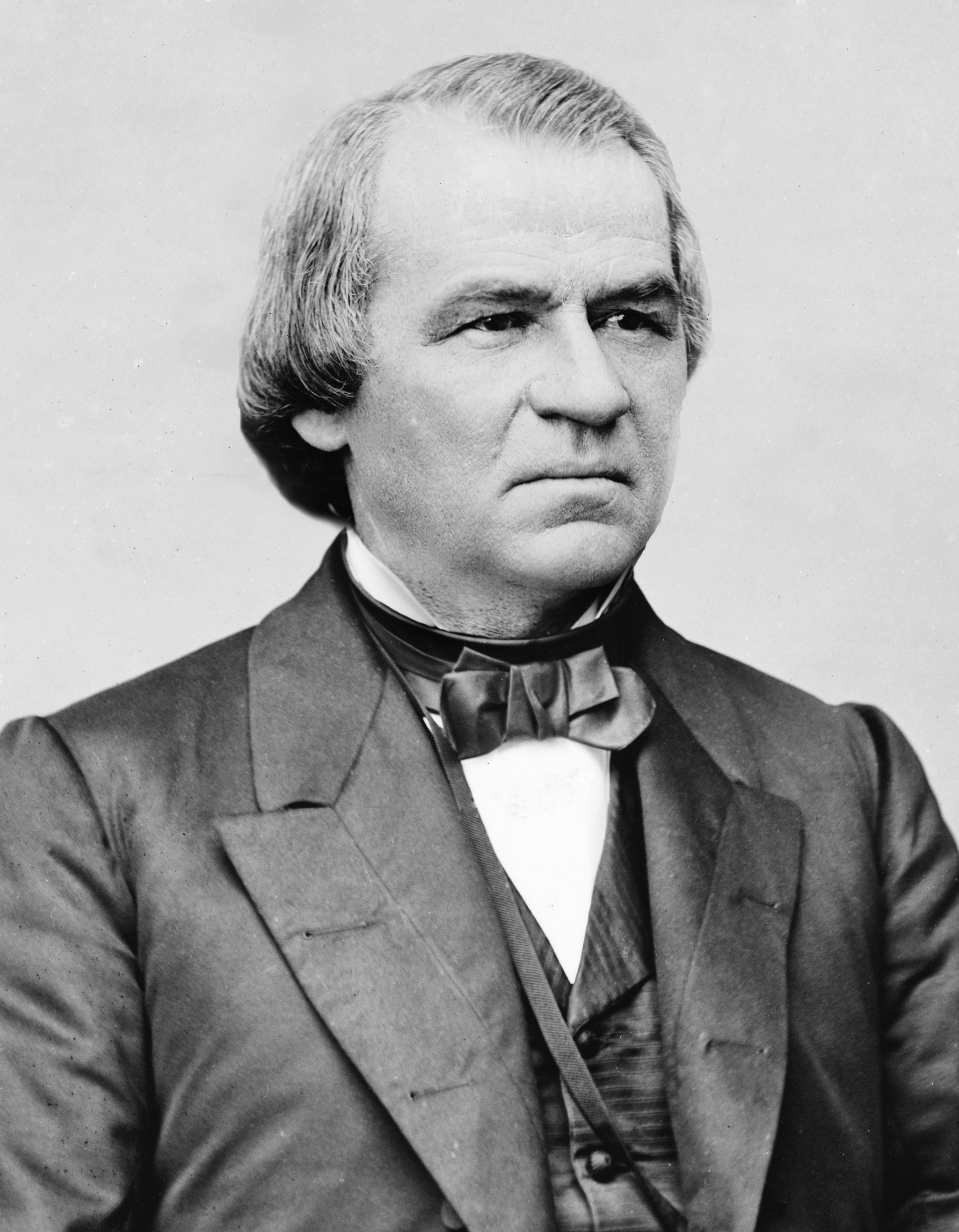
Portrait of Andrew Johnson
The Tailor Who Would Not Be Moved
Andrew Johnson learned to read as an adult, over a tailor's bench in Greeneville, Tennessee, while a hired man read the newspaper aloud for the price of a coin. Everything about his later career carries the mark of that apprenticeship: a self-taught literalism, a suspicion of polish, a conviction that a man who worked his own way up owed no deference to men who hadn't. He rose from journeyman tailor to alderman to governor to senator to president on exactly one political instinct, applied with total consistency for forty years — that the Constitution as he understood it, and the Union as he had sworn to defend it, were fixed points that did not bend for circumstance, sympathy, or Congress.
That consistency made him, in 1861, the only sitting senator from a seceding state to keep his seat and denounce secession to the Senate's face. It made him, in 1865, the only man in Lincoln's official family who could plausibly claim to have paid for his loyalty in advance. And it made him, from 1865 to 1869, a president who fought Reconstruction as though it were still 1861 — a rebellion to be put down by the correct application of constitutional principle, rather than a shattered society to be rebuilt by persuasion, coalition, and improvisation he had neither the temperament nor the imagination to attempt.
Johnson governed like a man refereeing a fight he had already decided the outcome of — an ESTJ's dominant Te certain of its verdict, deaf to how the verdict sounded to anyone still watching.
The Presidency as a Ruling to Be Enforced
Johnson's Te showed itself first as raw administrative nerve. As military governor of occupied Tennessee from 1862, he ran the state under martial law with a bluntness that alarmed even Union allies — arresting secessionist clergy, closing hostile newspapers, forcing Confederate sympathizers to swear loyalty oaths or lose their property. He did not consult; he decided, then enforced the decision. Lincoln put him on the 1864 ticket precisely because that hardness read, in a border-state Democrat, as proof the Union could survive on will alone.
As president the same instinct became a program. Johnson issued sweeping pardons and reconstructed state governments within months of Appomattox, largely without asking Congress's leave, because he had already worked out — to his own satisfaction — what reunification required, and did not see why anyone's ratification was necessary. When Congress answered with the Civil Rights Act of 1866 and the Freedmen's Bureau bill, he vetoed both, in messages that read less like negotiating positions than like verdicts handed down from the bench. Congress overrode him on the Civil Rights Act, the first override of a presidential veto on major legislation in the nation's history — a fact Johnson treated not as a signal to adjust but as an outrage to be resisted harder.
The Tenure of Office Act crisis in 1868 is Te at its most self-certain: rather than test the law in court or wait it out, Johnson simply fired Secretary of War Edwin Stanton and dared Congress to do something about it. Congress impeached him. He was acquitted by one vote in the Senate, and treated the acquittal, characteristically, as full vindication rather than a warning shot.
A Constitution Fixed in 1789
Johnson's Si ran beneath his Te as the source of the precedent he was so certain about. He was a strict-constructionist Jacksonian Democrat to the bone, and his Reconstruction policy was, at root, an act of historical restoration: readmit the Southern states essentially as they had been before secession, on the theory that the Union had never legally been broken and so nothing structurally new needed to be built. States' rights, limited federal power, the presidency as the guarantor of an inherited constitutional order — these were not positions Johnson argued so much as facts he consulted, the way a man consults a remembered rulebook.
It was this same backward-anchored loyalty that made him, alone among Southern senators, refuse to follow Tennessee out of the Union in 1861 — not because he had reimagined the republic's future, but because he held fast to an oath and a precedent that predated the crisis and, in his mind, simply outranked it. The same instinct that made him admirably immovable in 1861 made him catastrophically immovable in 1866: he could not update the template. A Union restored on 1860's terms, with Black Americans left to the mercy of state governments he had just amnestied, was to him not a compromise but the only lawful outcome — precedent honored, not imagination failed.
One Formula, No Alternatives
What Johnson conspicuously lacked was any real appetite for imagining Reconstruction otherwise. A stronger tertiary Ne might have let him entertain, even provisionally, the possibilities Radical Republicans like Thaddeus Stevens and Charles Sumner were pressing on him — land redistribution, federal enforcement of Black suffrage, a reconstructed South built on genuinely new terms. Johnson never seriously weighed these as live options; he treated them as errors to be corrected, not as competing visions of the same problem he was also trying to solve.
Even his one truly improvisational gesture — the 1866 "Swing Around the Circle," a national speaking tour meant to build a coalition against his Congressional opponents — reveals how thin his tertiary function ran under pressure. Rather than adapt his message to different crowds or read the room, he delivered the identical grievance-laden speech in city after city, and when hecklers pushed back he abandoned the text entirely and traded insults with the crowd. It was the tour of a man with exactly one plan, unable to generate a second when the first visibly wasn't working.
Grievance Standing In for Conscience
Inferior Fi in Johnson surfaced not as absent feeling but as feeling with nowhere functional to go — a private, wounded sense of righteousness that could not translate into the values-calibration that lets a leader read how his own certainty is landing on other people. He genuinely believed himself the aggrieved party through most of his presidency: a self-made Southern Unionist besieged by Northern radicals who had never done the loyal, difficult thing he had done. That belief was not manufactured. It was sincerely, even painfully felt. But it never matured into anything he could use to build sympathy outward.
The result was a president who could not distinguish between conviction and provocation. On the "Swing Around the Circle," when hecklers shouted about Stanton and the vetoes, Johnson took their bait every time, matching insult for insult in front of reporters who wrote it all down. He experienced this as standing on principle. Audiences experienced it as a president who couldn't be baited without losing his composure — and it cost him precisely the coalition of moderate Republicans and War Democrats his own Reconstruction policy most needed to survive. An inferior function under strain rarely announces itself as inferior; it just keeps making the same move, more loudly, expecting a different result.
Why ESTJ Over ISTJ
Why not ISTJ?
An ISTJ president would have pursued the same strict-constructionist, precedent-bound Reconstruction, but from inside the lines — quietly vetoing, quietly administering, avoiding open confrontation as a matter of temperament. Johnson did the opposite: he toured the country picking fights with hecklers, fired a cabinet secretary in open defiance of a law he knew Congress would enforce, and treated impeachment as a stage rather than a warning. That is extraverted judging asserting itself outward and loudly, not introverted judging holding a careful internal line. The confrontation was the point, not a regrettable side effect of principle.
Johnson's ESTJ reading rests on that same distinction: the dominant function was never a private standard he applied to himself, but a public verdict he expected the country to accept because he had rendered it. Te-Si gave him the administrative nerve to hold Tennessee for the Union in 1861 and the constitutional literalism to justify readmitting the South on 1860's terms in 1866 — the same rigidity, aimed first at secession and then at Reconstruction, with no capacity in between to notice the two crises called for different tools.
Connected Figures
Further Reading
- Andrew Johnson: A Biography — Hans L. TrefousseThe standard full-length biography, unsparing on his political failures.
- Andrew Johnson — Annette Gordon-ReedConcise American Presidents series volume, strong on his racial views and their consequences.
- Reconstruction: America's Unfinished Revolution, 1863–1877 — Eric FonerThe definitive account of the era Johnson presided over and fought against.
