 Historical Figure MBTI
#409 · 4-6-26 · The Mongol Khanates
Phagpa Lama
Imperial Preceptor · Sage of Sakya
1235 — 1280
8 min read
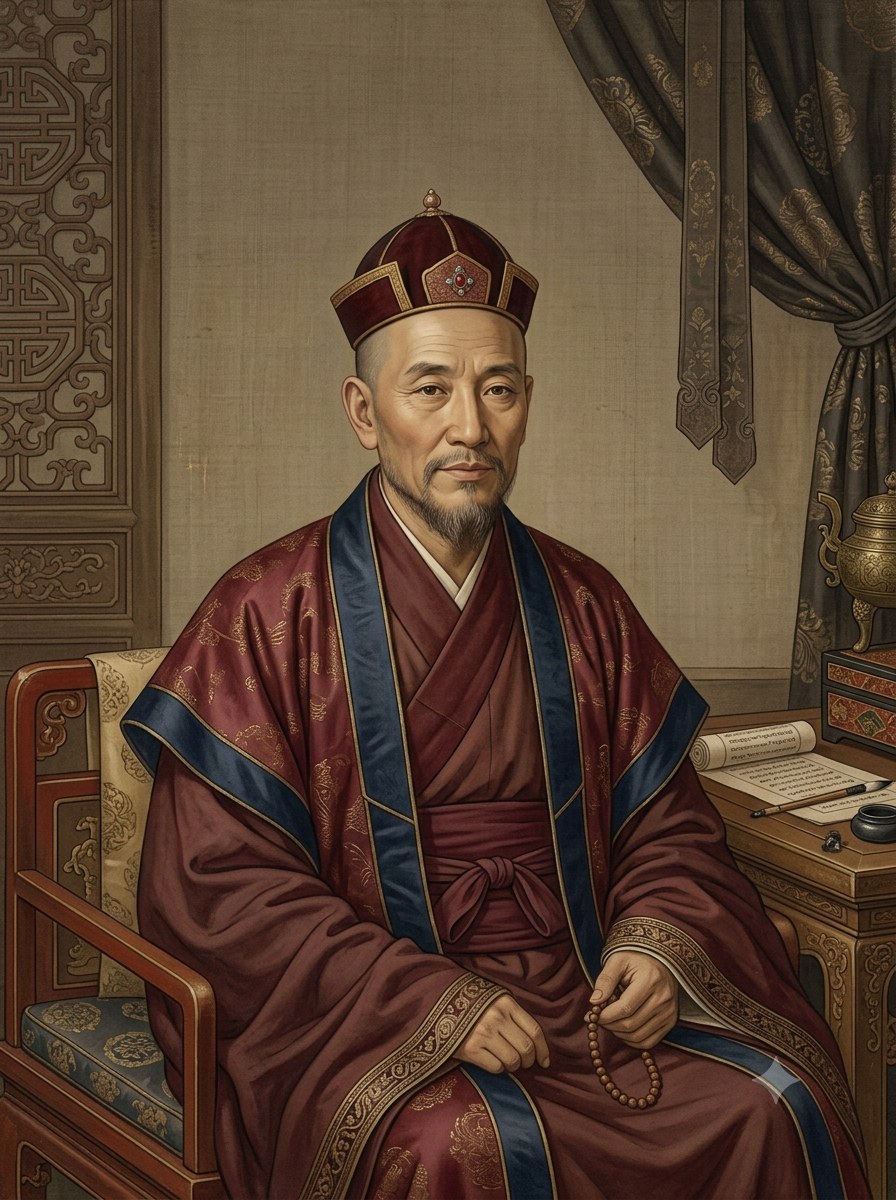
Portrait of Phagpa Lama
The Monk Who Gave an Empire Its Soul
When Kublai Khan looked for someone to consecrate a world-conquering dynasty in sacred terms, he turned to a Tibetan monk barely out of boyhood. Drogön Chögyal Phagpa — the name means “the noble dharma-king” — was a prodigy of the Sakya school who had entered Mongol service as a teenager and never really left it. By his early twenties he had become the most powerful religious figure in Asia's largest empire, the man Kublai named Imperial Preceptor, the Dishi: the throne's own teacher.
It was an improbable elevation. Phagpa held no army, governed no province by force, and won no battles. What he offered was harder to see and more lasting than any conquest — a vision of order in which the Mongol khan ruled not as a foreign warlord but as a Buddhist chakravartin, a universal wheel-turning king whose dominion was sanctioned by the dharma itself. In exchange for that legitimacy, Kublai granted the Sakya school temporal authority over Tibet. The bargain Phagpa struck would shape Tibetan governance — and Tibet's long, fraught relationship with the empires of China — for the next six centuries.
Phagpa was the INFJ in its rarest register: the mystic who builds institutions. He saw a single sacred order binding throne and monastery, and he spent his short life translating that inward vision into the architecture of an empire.
The One Script for All Tongues
Ni — dominant
Dominant Ni reaches for the single pattern beneath a sprawl of particulars, and Phagpa's grandest expression of it was an alphabet. In 1269, at Kublai's commission, he unveiled a wholly new vertical script — the ‘Phagpa script — designed to do something no writing system had attempted: render every language of the multiethnic empire, Mongolian and Chinese and Tibetan and Uyghur alike, in one unified set of letters. It was a staggeringly idealistic act of synthesis. Where others saw a Babel of mutually unintelligible peoples, Phagpa saw an underlying unity waiting to be made legible, and he tried to build the instrument that would express it.
The script was visionary and, in the end, impractical — it never displaced the established writing systems it was meant to harmonize, and it fell out of use within a generation of the Yuan's collapse. That arc is pure Ni: the far-seeing design that perceives a future coherence the present is not ready to hold. But the same faculty that produced an unworkable alphabet produced something that endured. Phagpa grasped, with a clarity few of his contemporaries shared, that a Mongol world-empire needed more than military supremacy — it needed a cosmology, a story about itself that placed the khan inside a sacred order. He supplied exactly that, and the priest-patron framework he envisioned outlived the dynasty that birthed it.
The Bond Between Priest and Patron
Fe — auxiliary
Ni supplied the vision; auxiliary Fe made it a relationship. Phagpa's signal achievement was not a doctrine but a bond — the chö-yön, the priest-patron tie between himself and Kublai. In this arrangement the lama offers spiritual teaching and legitimacy; the emperor offers protection and temporal power; and the two are joined not as ruler and subject but as something closer to spiritual master and devoted disciple. It was a profoundly Fe solution to a political problem: harmonize two kinds of authority by binding two people in mutual obligation and reverence.
Phagpa worked through people and through devotion, never through coercion. He won Kublai by being his teacher, and he secured his standing through the patronage of the empress Chabi, his great champion at court, whose piety made Buddhism fashionable in the Mongol household and gave the young lama room to operate. The relational instinct ran so deep that the empire's very legitimacy came to rest on a personal attachment — Kublai as bodhisattva-king, consecrated by a monk who loved him as a pupil. Fe at this pitch does not merely read a room; it reorganizes power around the warmth and obligation at its center.
The Scholar's Precision
Ti — tertiary
Beneath the mystic and the courtier sat a rigorously trained mind. Phagpa was the nephew and pupil of Sakya Pandita, the foremost scholar-monk of the age, and he inherited the Sakya tradition's reputation for analytic exactness — its fluency in logic, doctrinal classification, and the disciplined parsing of texts. The tertiary Ti shows in the technical labor that vision alone could never have produced: an alphabet does not get built by inspiration but by working out, letter by letter, how the sounds of four unrelated language families might be mapped onto a single internally consistent system.
That structural intelligence served the larger Ni-Fe project. Phagpa composed doctrinal works to instruct his royal patrons, framing the Mongol conquest within a coherent Buddhist account of kingship — a system in which the khan's authority followed logically from his role in the sacred order. The tertiary function is rarely the headline, but here it was the craftsman's hand behind the prophet's eye: the part of Phagpa that could take a sweeping vision of unity and render it precise enough to teach, to codify, and to write down.
A Monk Among Warlords
Se — inferior
Inferior Se is the function of the immediate, the physical, the brute fact of the present moment — and Phagpa lived his entire life at the heart of the most Se-saturated power on earth. The Mongol Empire ran on cavalry, plunder, and the realities of force; its khans were men of the saddle and the battlefield. Phagpa met that world not by competing in it but by offering an alternative currency entirely. He had no interest in conquest or in the sensory spectacle of power for its own sake; his instrument was meaning, not might.
The cost of that orientation showed at the end. Phagpa returned to Tibet to govern as the Sakya school's spiritual head, and there the inferior function turned against him: the messy, factional, on-the-ground realities of Tibetan politics were precisely the terrain a visionary least equipped to navigate. He died in 1280, only forty-five, amid suspicion that he had been poisoned by a rival administrator. The man who could envision a sacred order spanning an empire was undone by the immediate, physical brutality of local power — the inferior Se claiming, as it so often does, the very thing the dominant function had built.
Why INFJ Over INTJ
Why not INTJ?
The INTJ and the INFJ share the same dominant Ni — the visionary's eye for a hidden pattern — and at a glance Phagpa's grand designs could read as cold strategy. But the INTJ pursues vision through impersonal, secular calculation, treating people and ideas as instruments toward an end. Phagpa worked through devotion, relationship, and sacred meaning. His unifying alphabet was not a power-tool but an idealistic act of harmony, and the priest-patron bond he forged was an Fe achievement of mutual reverence, not an INTJ's leverage play.
The decisive difference is the register of his ambition. An INTJ in Phagpa's position would have read the Mongol throne as a system to be mastered — a lever for advancing Sakya interests through shrewd, dispassionate maneuver. Phagpa instead poured his life into a religious vision of unity: an empire bound to the dharma, a khan consecrated as a bodhisattva-king, two kinds of authority joined in sacred obligation. His Ni was suffused with spiritual meaning and channeled through personal attachment, never the dry strategic intelligence of the INTJ. He was a mystic who happened to wield enormous power — not a strategist who happened to wear robes.
Connected Figures
Further Reading
- Khubilai Khan: His Life and Times — Morris RossabiThe standard English biography of Kublai — essential on Phagpa's role at court and the Buddhist legitimation of Yuan rule.
- Tibet: A History — Sam van SchaikA lucid one-volume history that sets the priest-patron relationship and the Sakya ascendancy in their long Tibetan context.
- The Cambridge History of China, Vol. 6: Alien Regimes and Border States, 907–1368 — Herbert Franke & Denis Twitchett (eds.)The authoritative scholarly account of the Yuan, including the imperial preceptorship and Tibet's place in the empire.
