 Historical Figure MBTI
#404 · 4-6-26 · The Mongol Khanates
Zhenjin
Crown Prince of the Yuan · The Heir Who Died First
1243 — 1286
8 min read
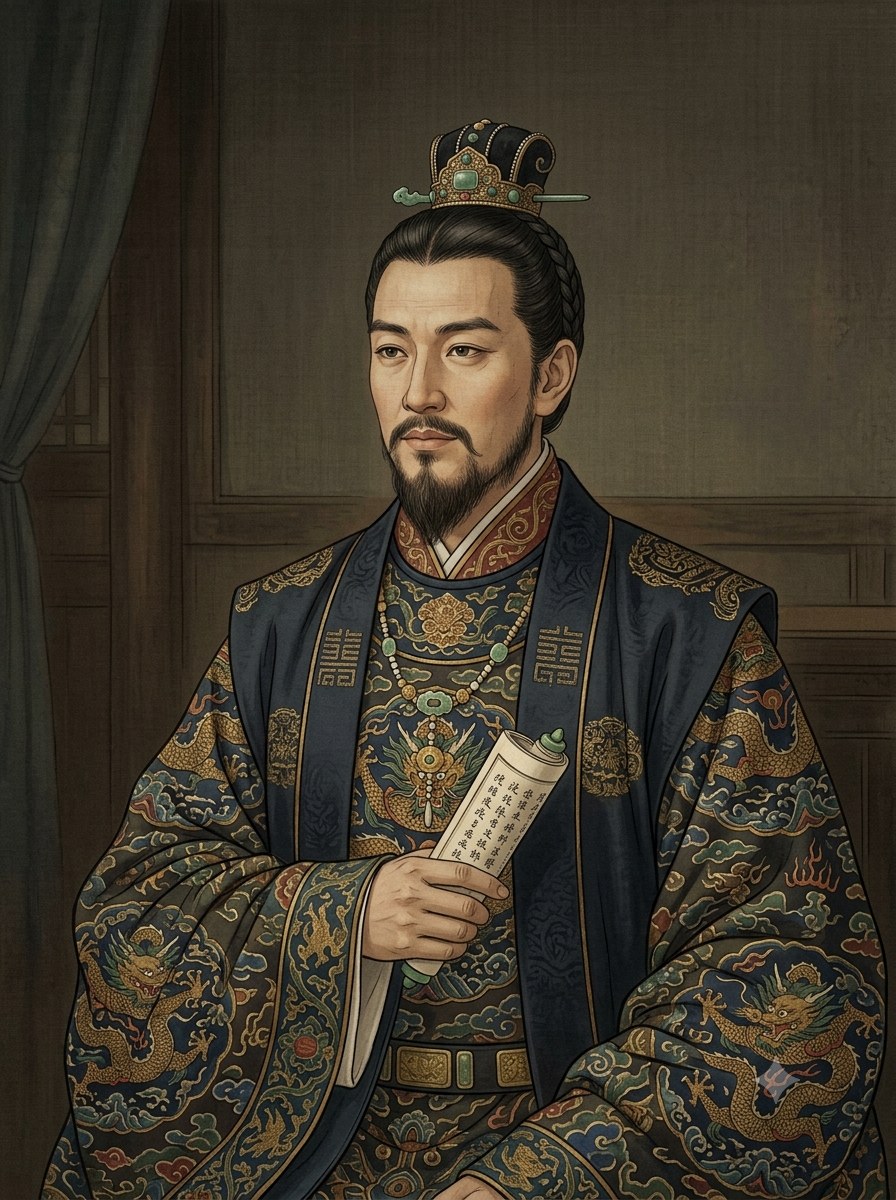
AI-assisted Portrait of Zhenjin
The Bridge Between Two Worlds
He was the future the Yuan never got to have. Zhenjin—known to the Chinese chronicles as Jingim—was the second son of Kublai Khan and the Empress Chabi, named Crown Prince of a dynasty that ruled both the Mongol steppe and the oldest civilization on earth. From boyhood he was handed to Chinese tutors and raised on the Confucian classics, and he became, in the most literal sense, a living bridge: a Mongol prince who could speak the language of the scholar-officials, honor their rites, and govern by their book. To the Han bureaucrats who feared their world was being dismantled by steppe conquerors and foreign tax-farmers, Zhenjin was the hope that the empire might yet be ruled the right way.
He never reigned. Zhenjin died of illness in 1286, at roughly forty-three, the year before his father—a blow from which the aging Kublai never fully recovered. What survives of him is not conquest or decree but a temperament: dutiful, gentle, conscientious, almost painfully proper. He absorbed an inherited tradition and held it as a trust; he sought harmony where others sought leverage; and he was terrified, above all, of being seen to want anything for himself.
Zhenjin is the ISFJ in a robe of Confucian propriety—dominant Si steeped in precedent and learning, auxiliary Fe bent toward duty and the moral order, a man who wanted nothing so much as to be good in the eyes of his father and his people.
The Keeper of the Inherited Order
Si — dominant
Dominant Si learns a tradition deeply and then treats it as something to be kept faithfully, not reinvented. Zhenjin's whole education was an exercise in this. While his Mongol cousins were raised to the bow and the hunt, he was set down before Confucian masters to memorize the classics, the rites, the precedents of good government—and he did not merely tolerate the lessons, he made them his own. By temperament he was the model student of the Sinicization his father's regime was drifting toward: steady, deferential, conscientious, more comfortable upholding an established way of doing things than improvising a new one.
That is why the Confucian scholar-officials looked to him as their own. The deep administrative quarrel of Kublai's court pitted the Chinese-style bureaucracy—rule by educated officials, by ritual propriety, by the moral example of the prince—against the Central Asian and Mongol finance ministers who ran the empire as a revenue machine, most hatefully Ahmad Fanakati, whose tax-farming the Han literati loathed. Zhenjin stood, by instinct and upbringing, with the scholars and the inherited order. The continuity of a proven tradition felt to him like safety; the foreign financiers' improvisations felt like the slow corrosion of something that ought to be preserved.
This is Si as conscience rather than nostalgia. Zhenjin did not romanticize the past for its own sake; he had absorbed a particular vision of how an emperor and his ministers should behave, and he held himself—and hoped to hold the dynasty—to that standard. His authority was not the conqueror's improvisation but the steward's fidelity: keep faith with the model you were given, and govern by it.
The Dutiful Son and the Fear of Grasping
Fe — auxiliary
If Si gave Zhenjin his reverence for the inherited order, auxiliary Fe is what bent that reverence outward into relationships—devotion to his father, care for correct conduct, an instinct to harmonize rather than to seize. He was, by every account, gentle and pious, attuned to how he appeared in the eyes of others and to the moral weight of his place. The Confucian frame fit his Fe perfectly: it made filial piety and proper relations between ruler and minister into the very architecture of virtue, and that was an order Zhenjin wanted with his whole heart to honor.
The most revealing episode of his life turns entirely on this. As Kublai aged, a Chinese censor submitted a memorial suggesting the old Khan abdicate and hand the throne to his Crown Prince. To an ambitious heir it might have been welcome; to Zhenjin it was a horror. He was terrified—not of the political danger alone, but of the appearance of grasping at his own father's throne, of seeming to want what filial duty said he must never be seen to want. The affair distressed him deeply, and he worked to have the matter buried. A more self-interested or systems-minded heir would have weighed the opportunity coldly. Zhenjin felt it as a violation of the moral relationship between father and son.
Offered his father's crown a step early, Zhenjin's first feeling was not ambition but dread—the auxiliary Fe of a man who could not bear to be seen reaching for something duty forbade him to want.
The Principled Mind Behind the Manners
Ti — tertiary
Tertiary Ti in an ISFJ does not make a cold logician; it gives the warm, dutiful temperament a spine of principle—a private sense that things ought to hang together, that a position must be coherent and not merely convenient. Zhenjin's backing of Confucian governance was not just sentiment. It was a considered preference for a system of rule he could defend on its own terms: government by educated officials accountable to ritual and precedent, against the ad hoc extraction of the finance ministers. He had reasons, not only loyalties.
But tertiary Ti is a support function, not the engine, and in Zhenjin it stayed in service of Si and Fe rather than overriding them. He could grasp the logic of a hard political choice; he was far less willing to act on that logic if doing so meant violating propriety or wounding a relationship—witness his recoil from the abdication memorial, where any purely strategic calculation was overwhelmed by the impropriety of the thing. His intelligence sharpened his convictions; it did not license him to be ruthless in pursuing them. That is Ti as the quiet auditor of a fundamentally dutiful character, not its master.
The Anxious Edge of Possibility
Ne — inferior
Inferior Ne is the ISFJ's weak spot: an uneasy relationship with open-ended possibility, with the unsettling proliferation of what might happen. Where a strong Ne reads ambiguity as opportunity, Zhenjin tended to read it as threat. The abdication affair is again the clearest window: confronted with a sudden, unscripted situation that could be spun in a dozen directions—ambition, coup, his father's displeasure, the censor's motives—he did not seize the opening. He was frightened by the cloud of dangerous interpretations it raised, and his instinct was to close the possibility down and return to the safety of established roles.
The same shadow falls across his standing at court. To live as the Confucian hope inside a regime still run, in large part, by the very financiers he opposed was to inhabit a future that was never guaranteed—and Zhenjin, temperamentally, was not the man to gamble boldly on remaking it. He preferred to embody the proven model and trust it to prevail rather than to scheme his way toward an uncertain new arrangement. It is one of history's quieter ironies that the open future he found so hard to seize was the one thing fate denied him: he died before he could ever test what kind of emperor he would have been.
Why ISFJ Over ISTJ
Why not ISTJ?
The ISTJ shares Zhenjin's dominant Si—the reverence for precedent, the dutiful fidelity to an inherited order—and from a distance the two look alike. The break comes on the auxiliary. An ISTJ filters duty through Te: impersonal logic, systems, and procedure, loyal to the rules more than to the relationships the rules serve. Zhenjin's orientation was warm, relational, and harmony-seeking. His backing of Confucian governance was not the cool administration of a code but a moral and filial devotion—and his defining moment, the dread of seeming to grasp at his father's throne, is pure Fe anxiety about how he would appear in others' eyes, not a Te calculation of whether the transfer of power was procedurally sound.
The distinction is one of motive beneath identical manners. Both types keep faith with the past; the question is what they are ultimately serving. The ISTJ serves the system—the ledger, the protocol, the chain of authority—and treats people as positions within it. Zhenjin served the moral relationship: he wanted, above all, to be good, and to be seen as good, in the bond between a son and his father and between a prince and his people. That warmth at the center, governing even his politics, is what makes him an ISFJ and not an ISTJ.
Connected Figures
Further Reading
- Khubilai Khan: His Life and Times — Morris RossabiThe standard English biography of Kublai; the fullest account of Zhenjin's upbringing, his role as Confucian heir, and his early death.
- The Cambridge History of China, Vol. 6: Alien Regimes and Border States — Herbert Franke & Denis Twitchett, eds.The authoritative scholarly survey of the Yuan and its neighbors — essential context for the court politics and Sinicization debate Zhenjin embodied.
- China Under Mongol Rule — John D. Langlois Jr., ed.Essays on Yuan governance and the tension between Mongol rule and Chinese institutions that defined Zhenjin's political world.
