 Historical Figure MBTI
#1210 · 9-4-26 · The Mughal Empire
Ruqaiya Sultan Begum
Mughal Empress · Dynastic Elder
1542–1626
5 min read
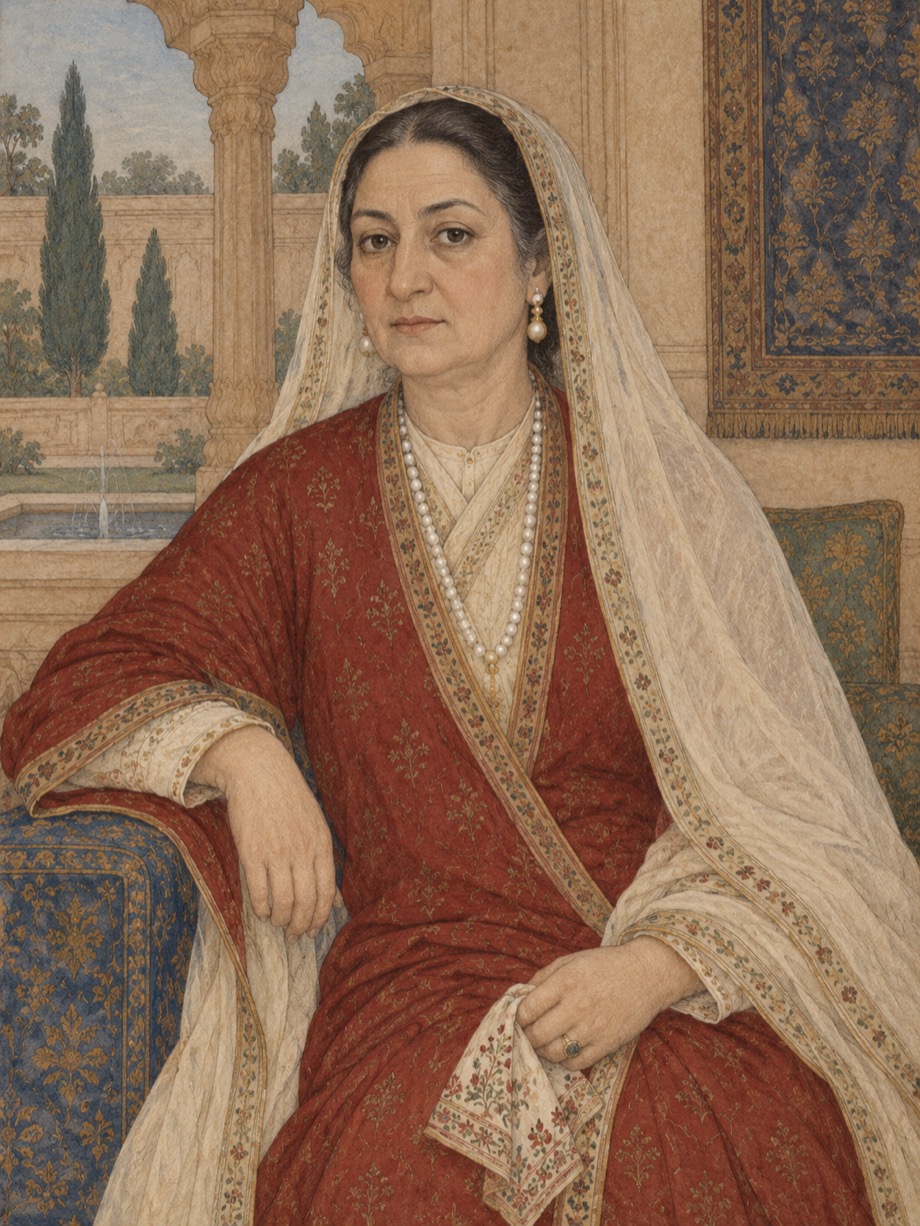
AI-assisted Portrait of Ruqaiya Sultan Begum
The child placed in her charge
Jahangir remembered a decision his father had made: the young prince Khurram was entrusted to Ruqaiya Sultan Begum. The emperor's grandson would grow into Shah Jahan, but that future should not swallow the arrangement through which he was raised. A senior wife of Akbar, herself descended from Babur, held responsibility for a child born to another woman. Biological parenthood and household guardianship occupied distinct places inside the dynasty, and both places mattered.
Ruqaiya remains untyped. Jahangir's praise of her attachment to the boy is testimony to how he chose to honor her, not an invitation to reconstruct every feeling she had about raising him. The record preserves kinship, standing, property, and a few consequential occasions. It offers no sustained account of how she deliberated. Refusing a personality label does not empty this life of character; it keeps the character visible in documented relations rather than manufactured motives.
Hindal's daughter
Her father was Hindal Mirza, a son of Babur and a younger half-brother of Humayun. Hindal died in 1551 during the dynasty's violent internal struggle. Ruqaiya's marriage to Akbar linked his branch to the line that regained the principal throne. The marriage occurred while the future of that throne remained uncertain, before Akbar's accession in 1556 transformed a young prince into the dynasty's sovereign.
It is possible to recognize the importance of a father's early death without inventing the daughter's response. We have no childhood journal to tell us what she understood of the fighting or how she remembered it. Gulbadan Begum's grief for Hindal belongs to an aunt who wrote about her own full brother. It cannot be silently transferred into Ruqaiya's mind. The family relationship provides context for her position, while the surviving testimony must remain attached to the person who gave it.
A senior presence through a long reign
Ruqaiya lived through the expansion and consolidation of Akbar's empire and remained a senior figure in its household. That standing derived partly from her place among his earliest wives and partly from Timurid descent. Neither description requires arranging all the emperor's wives into a permanent ladder of personal affection. Their authority could arise from different sources, and those sources could acquire different weights at different moments.
The household itself was an institution of residence, kinship, patronage, and political access. Its women were not interchangeable occupants waiting for an emperor's attention. They had attendants, resources, seniority, and relationships that continued beyond any single encounter with him. Ruqaiya's visible career makes more sense inside that structure than inside a romantic contest. The surviving record does not permit us to rank her happiness against that of another consort, nor should later fiction supply the rivalry required to make such a ranking dramatic.
Guardianship without substitution
Khurram was the son of Salim and Jagat Gosain. Akbar placed him in Ruqaiya's care. Jahangir later commemorated her devotion in language of extraordinary affection, making the guardianship part of his own account of the family. His memoir thus establishes the arrangement and his positive judgment of it. It does not establish that the child ceased to have a mother, or that the arrangement tells us everything about relations among the adults involved.
Raising a prince also meant responsibility exercised through a substantial household. Attendants and other specialists necessarily participated in the work, although the brief notice does not list them. Royal care was both personal and organized. Recognizing its institutional scale does not strip Ruqaiya of credit; it prevents an anachronistic image of a solitary caregiver from replacing the arrangement that actually existed.
The future emperor's importance has encouraged later writers to make the guardianship a complete explanation of Ruqaiya's life. It is a major event, but the adult woman was already a person of established standing when it occurred. The decision itself demonstrates confidence in that standing. It should be read as a responsibility placed within an existing relationship, not as the moment she first acquired a meaningful place in the dynasty.
The garden and the visit
After Akbar's death, Jahangir gave Ruqaiya an Agra garden formerly held by Shah Quli Khan, who had left no heirs. The notice follows her identification as Hindal's daughter and his father's honored wife. Property makes the respect material. She was not merely retained as a memory of the previous reign: her position continued to receive acknowledgment through an allocation of resources in the new one.
The memoir also records her visit to Hindal's tomb during the imperial journey to Kabul in 1607. This brief occasion joins the older genealogy to the living woman. The father killed before Akbar's accession remained commemorated within the dynasty after Akbar's death. We cannot infer from the notice exactly how Ruqaiya experienced the visit. Its historical meaning is clear enough without that inference: a senior woman could publicly occupy her place in the remembrance of her own branch of the family.
Connected Figures
Further Reading
- The Tuzuk-i-Jahangiri; or, Memoirs of Jahangir — Jahangir; translated by Alexander Rogers; edited by Henry BeveridgeThe primary source for Khurram's guardianship, the garden gift, and the visit to Hindal's tomb.
- Domesticity and Power in the Early Mughal World — Ruby LalProvides a framework for household authority beyond biological motherhood.
- The History of Humayun (Humayun-nama) — Gulbadan Begum; translated by Annette S. BeveridgePreserves the family history behind Ruqaiya's Timurid descent.
- The Mughal Empire — John F. RichardsPlaces the generations she outlived within the expansion of Mughal government.
