 Historical Figure MBTI
#857 · 6-20-26 · The American Civil War
Sojourner Truth
Abolitionist · Preacher · 'Ain't I a Woman'
c. 1797 — 1883
8 min read
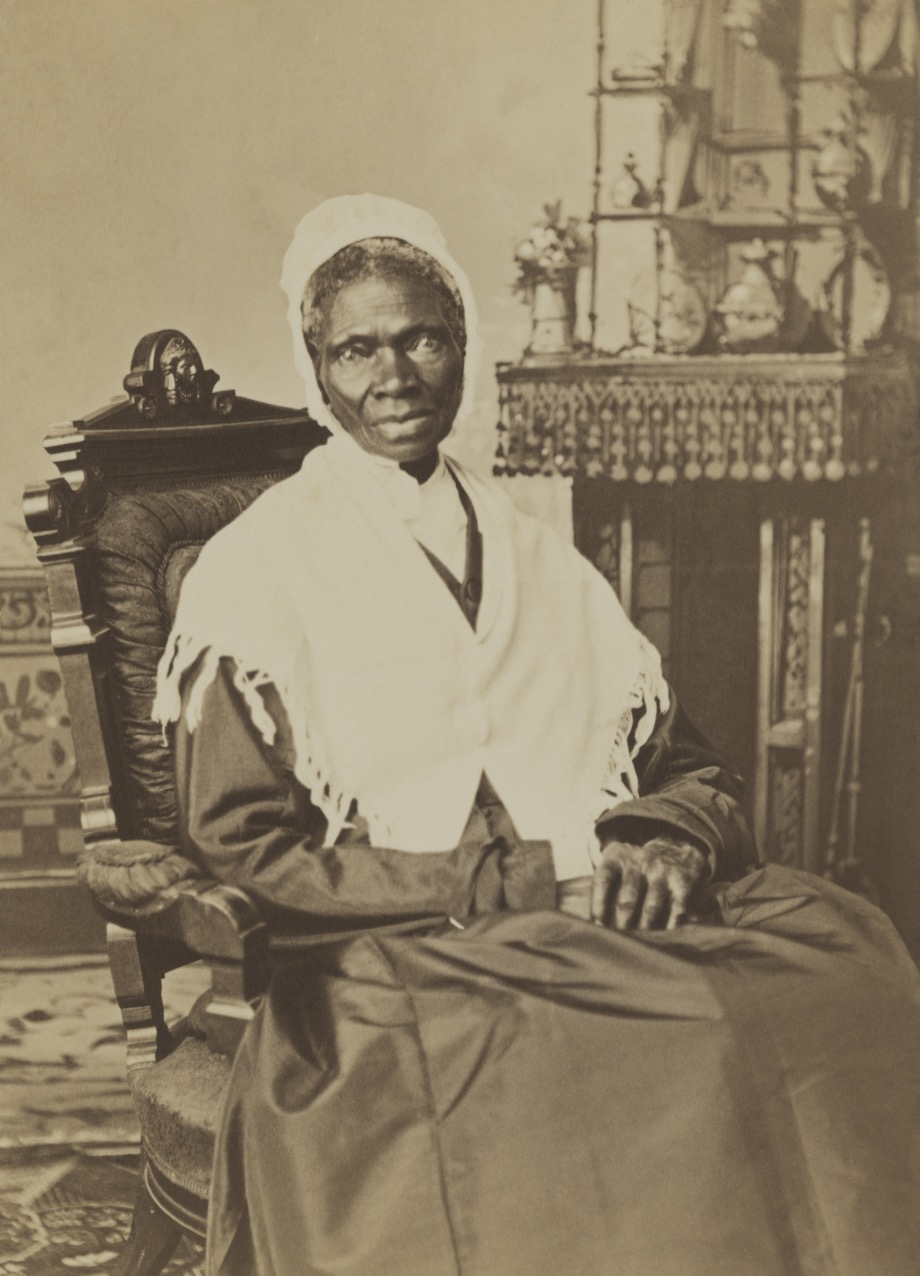
Portrait of Sojourner Truth
The Woman Who Named Herself
She could not read a word of the book she preached from, and she never wrote a sentence of the speeches that outlived her. What she had instead was a body, a voice, and an unerring instinct for the exact moment a room turned. Nearly six feet tall, with a low register that carried to the back of a hostile hall, she walked into camp meetings and convention floors where she had not been invited and left them rearranged. Everything we have of her reaches us secondhand, through the pens of allies and editors — and the figure keeps its shape anyway, because the thing being described was never textual to begin with. It was presence.
She was born Isabella Baumfree around 1797 in Ulster County, New York, enslaved and Dutch-speaking, sold away from her parents as a child along with a flock of sheep. In 1826 — with New York's gradual emancipation law nearly, but not quite, in force — she walked away at dawn carrying her infant daughter, later saying she did not run, because running would have looked like theft; she simply left, in daylight, having decided the arrangement was over. Then she did what almost no formerly enslaved woman in America had done. Her son Peter had been sold illegally across the state line into Alabama, and she sued a white man for his return, and she won.
In 1843 she left New York City on foot with a change of clothes and a new name — the old one belonged to the men who had owned her, and the new one was a description of the work. She was roughly forty-six, and she had just invented the person the rest of the century would have to reckon with.
Sojourner Truth was an ENFJ — a dominant-Fe orator who read the emotional architecture of a crowd the way a carpenter reads a beam, and struck exactly where it would give.
Fe — The Room Is the Instrument
Extraverted Feeling is often mistaken for warmth alone. In Truth it was warmth with a blade in it. Her method was never to deliver a prepared argument; it was to stand up after someone else had spoken, absorb what the hall was feeling, and answer that. At the 1851 Women's Rights Convention in Akron, the clergymen present had been making the genteel case that women were too delicate for the vote — too weak, too fine, too much in need of being lifted over puddles. Truth stood, held up an arm that had done field labor for four decades, and located in one gesture the contradiction the entire room had agreed not to see.
The famous refrain now attached to that speech — the challenge remembered as "Ain't I a Woman?" — almost certainly did not leave her mouth in the form we quote. Frances Gage published her version twelve years later, in a Southern dialect Truth, raised speaking Dutch in the Hudson Valley, would never have used. But the flag cuts both ways. The reason a transcriber could impose a legend on that speech is that everyone present agreed something enormous had happened in the room, and no one had written it down, because they had been too busy being moved.
She worked hostile crowds the same way. Heckled at an Indiana meeting on the claim that she was secretly a man, she reportedly bared her breast and told the audience the children she had nursed were white men's, and the shame was theirs, not hers — an attempted humiliation turned into an indictment in under a minute. That is Fe at full command: not seeking a group's approval but taking hold of its feeling and pointing it somewhere.
Ni — A Voice Told Her to Go East
The improvisation rested on something that never moved. In 1843 Truth described receiving what she understood as a direct instruction from God: leave, travel, testify. She acted on it immediately and irreversibly, shedding her name, her city, her domestic life and the perfectionist commune she had been living in, and setting out on foot toward New England with no plan beyond the certainty itself. Introverted Intuition rarely arrives with supporting evidence. It arrives as an already-finished conclusion that the person then spends decades justifying by living it out.
What is remarkable is the duration. A conviction that grand, adopted at forty-six, might reasonably have burned off in five years. Hers held for forty, and it gave her the leverage to refuse a trade nearly everyone around her accepted as necessary. When white suffragists after the war argued that the woman's ballot should come first and Black men's second, and when Black abolitionists argued the reverse, Truth would not choose. She warned that if colored men got their rights and colored women did not, the men would be masters over the women, and the trouble would be worse than before — a structural forecast made from nothing but pattern recognition, and one the next century proved out.
Late in life she pushed a scheme to settle freedpeople on Western land grants, gathering thousands of petition signatures for a Congress that never acted. It failed completely, and she kept at it anyway — what auxiliary Ni looks like when the vision is not negotiable.
Se — The Argument Made of Muscle
Truth's rhetoric was overwhelmingly physical. She did not describe slavery in the moral abstractions the movement's pamphleteers favored; she offered her own arm, her own scarred hand, the children she said had been born and sold away from her. The body was the evidence, and she put it in front of people who had spent their lives arranging not to look at it — tertiary Extraverted Sensing doing real work, an immediate grasp of what will land in a physical space.
It shows up outside the pulpit too. In Washington during and after the war, she repeatedly rode the capital's segregated streetcars, refusing to be put off, forcing conductors into public confrontation, and taking one to court after he wrenched her shoulder — a full century before Montgomery. She did not argue the principle in a journal. She got on the car.
Ti — The Logic She Kept in Reserve
Inferior Introverted Thinking in an ENFJ is not an absence of reasoning; it is reasoning that only comes out under pressure, in short unadorned strokes. Told by a heckler that her speeches were no more consequential than a flea bite, she agreed — and answered that the Lord willing, she would keep them scratching. When Frederick Douglass, despairing on a platform, said the enslaved would have to win freedom by the sword, she cut through from the audience with a single question about whether God was dead: a reframing that collapsed his premise in five words.
Its limits show in systems rather than exchanges. She could not read contracts and was defrauded more than once, most seriously by the Kingdom of Matthias, whose leader took her savings before the commune collapsed in scandal. She sued for slander afterward and won, which is the pattern: formidable in a confrontation, vulnerable to the slow documentary manipulation that never gave her a room to work.
Her financial independence, when it came, came the ENFJ way. She had the Narrative dictated to Olive Gilbert in 1850, then sold copies from the stage at her own lectures, along with cartes de visite of herself captioned "I Sell the Shadow to Support the Substance" — one of the shrewdest self-branding lines of the nineteenth century, from a woman who could not read it.
Why ENFJ Over INFJ
Why not INFJ?
The visionary certainty and the religious calling read as INFJ, and many typings stop there. But an INFJ's influence tends to be interior and mediated — the written testimony, the small circle, the carefully composed argument released into the world at a distance. Truth's power was the opposite in kind: extemporaneous, physical, and dependent on being bodily present in front of people who did not want her there. Four decades of barnstorming travel undertaken to stand before crowds, plus a habit of building her best material out of whatever a heckler had just handed her, points to dominant Fe with Ni in support — not the reverse.
The clean test is what happened to her words when she was not there. Everything survives in someone else's transcription, much of it distorted, and the distortions did not diminish her standing in her own lifetime by a fraction — because the people who mattered had heard her. An INFJ's legacy is the text; Truth's is the eyewitness account of the performance.
Connected Figures
Further Reading
- Sojourner Truth: A Life, A Symbol — Nell Irvin PainterThe standard biography, and the book that separated the woman from the legend built on top of her.
- Narrative of Sojourner Truth — Sojourner Truth, dictated to Olive GilbertHer own account, spoken aloud in 1850 and sold from the stage at her lectures.
- Sojourner Truth's America — Margaret WashingtonPlaces her in the Dutch-speaking Hudson Valley and the evangelical currents that shaped her calling.
- The Libyan Sibyl — Harriet Beecher StoweThe 1863 Atlantic Monthly profile that made her nationally famous — and romanticized her considerably.
