 Historical Figure MBTI
#856 · 6-20-26 · The American Civil War
Robert Smalls
Enslaved Pilot Turned Union Hero · Congressman
1839 — 1915
8 min read
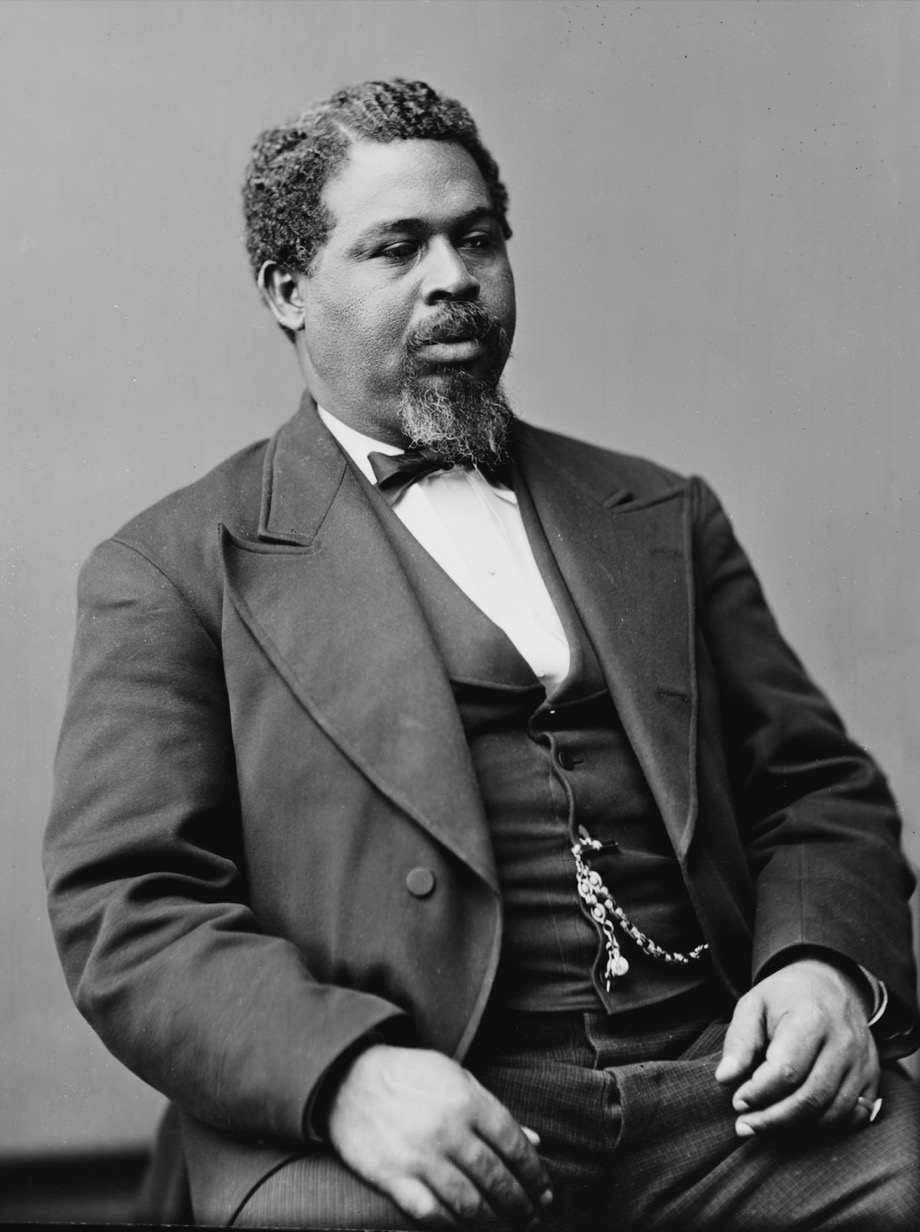
Photographic Portrait of Robert Smalls
The Man Who Stole a Warship
At three in the morning on May 13, 1862, a Confederate transport steamer called the Planter eased away from a Charleston wharf with a man in the captain's straw hat standing at the wheel. The posture was the captain's, the slouch was the captain's, the arms folded in that particular indolent way were the captain's. The whole silhouette was a forgery, and the forger was a twenty-three-year-old enslaved wheelman named Robert Smalls. He blew the correct signal at Fort Johnson, the correct signal at Fort Sumter, and then, past the last gun, ran up a bedsheet and steered for the Union blockade with sixteen people aboard who had gone to sleep as property and would wake up free.
It is almost always told as an adventure story. It is more interesting as an operation. Smalls did not improvise a dash for freedom; he engineered one. He had learned the harbor as a hired-out laborer until he knew its channels, mines, and passwords better than most white pilots. He had arranged for his wife Hannah, their children, and the crew's families to be waiting at a second dock. He had established that the officers' habit of sleeping ashore was regular enough to bet lives on. And he had the ship's four guns aboard as a deliverable — because an escapee arrives as a refugee, but a man delivering a warship arrives as an asset.
Smalls is the archive's clearest wartime ENTJ: a dominant Te that treats the world as a system with exploitable seams, and does not stop at escaping the system when it can be captured and run instead.
Te — The Operation, Not the Impulse
Extraverted Thinking asks what has to be true for a plan to work, then makes those things true. Smalls needed a ship he could handle: he spent years converting hired-out dock labor into rigging work, sail work, and finally the wheel of a steamer, until the Confederate navy relied on him to thread that harbor. He needed the signals; he memorized them. He needed a window; he tracked the officers until the gap was predictable. He needed a crew that would not panic; he briefed them in advance. Every element was a prerequisite satisfied before the ship moved.
The same habit governs what he did with the reward. Congress voted him prize money; he spent part of it buying the Beaufort house in which he had been enslaved — a transaction, not a gesture. When Reconstruction opened elected office to him he went into the machinery rather than orating from the margins: at the 1868 constitutional convention he pushed compulsory free public education and got it written in, and across five terms in the U.S. House he worked appropriations, harbor bills, and civil-rights amendments. He wanted Black men in uniform rather than merely armed, because a uniform is a claim on the state that a rifle is not. Freedom held informally is freedom held at someone else's pleasure; the durable version is in the statute book, defended from an office you occupy.
Ni — Seeing the Second Move Before the First
What separates Smalls from a merely competent operator is that his plans were aimed past their obvious object. Stealing the Planter freed sixteen people; Smalls saw that it would do something larger. A Black man delivering a Confederate warship, its guns, and its signal book to the U.S. Navy was an argument in physical form, and Northern doubt about whether the enslaved could soldier had no answer for it. A man with only nerve stops at the blockade and accepts his freedom; Smalls treated his sudden celebrity as an instrument and cashed it at the point of maximum leverage, lobbying Washington for Black enlistment — a door that would put some 180,000 Black soldiers in Union blue.
The same long sight is why the collapse of Reconstruction did not paralyze him. He saw the shape of what was coming — the prosecutions aimed at Black officeholders, the Red Shirts, the legal strangulation of the franchise — and kept working anyway, because his read of the endgame was measured in generations rather than election cycles. At the 1895 convention that disenfranchised South Carolina's Black voters he told the delegates plainly what it would cost. He lost the vote. He was not wrong about the century.
Se — The Captain's Slouch
No amount of planning gets a stolen steamer past Fort Sumter. Somebody has to stand in the open, in the dark, with a hundred guns trained on him, and be physically convincing. That is tertiary Extraverted Sensing. Smalls had watched Captain Relyea long enough to reproduce him — the hat, the posture, the folded arms — and had the composure to hold the impersonation for a full harbor transit with his wife and children below decks.
Se is also the source of his seamanship: he read current, tide, and channel by feel, and knew where the obstructions and torpedoes lay because he had spent his working life on that water. In December 1863, piloting for the Union, he took the helm of the Planter under Confederate fire when her white captain hid in the coal bunker — and was given command of the ship he had once been enslaved aboard. Held together with Te and Ni, that sensory nerve is what makes the type read as ENTJ rather than as a strategist on paper: Smalls's plans always ended with him personally at the controls, taking the risk in his own body.
Fi — The House in Beaufort
The inferior function in an ENTJ surfaces rarely and then decisively — a private moral floor the executive machinery is ultimately serving. In Smalls it sits at the hinge of the escape itself, which was at root not a strategic donation to the Union but a father getting his family off a wharf; every ingenious thing about it served something entirely unstrategic. It shows again in the story most often told about him: when the woman who had owned him, Jane McKee, returned in old age to the Beaufort house he now owned, he let her stay until she died. No political capital in it, and no rule requiring it — only a quiet judgment about what he was willing to be.
And it is Fi that gives his last speeches their force. By 1895 the arguments were lost, the coalition was gone, and the convention had the votes. Smalls spoke anyway — on the record, naming the lynchings and the fraud — because there are positions a person holds regardless of whether holding them can still be made to work. That is the inferior function speaking in a man whose life was otherwise organized entirely around what works.
Why ENTJ Over ESTJ
Why not ESTJ?
The ESTJ case is real: Smalls was a superb operator of existing systems, a hierarchy-literate professional who rose by mastering the waterfront's rules. But ESTJ works inside known procedure and established authority, and Smalls's defining act had no procedure to follow — impersonating a Confederate captain to sail a stolen warship past Sumter was a self-authored script staked on a read of how the situation would resolve. His politics point the same way: not maintaining an administration but building a Reconstruction that had never existed. Unprecedented gambles executed with total procedural competence is Ni feeding Te, not Si.
The cleanest test is what Smalls did with a solved problem. An ESTJ who reaches the blockade has finished — the objective was freedom, and freedom has been obtained. Smalls treated arrival as a new opening position: fame to be spent, an army to be opened, an office to be won, a constitution to be written and then, thirty years later, defended in its ruins. He kept converting each achieved end into the means of a larger one — the signature rhythm of dominant Te steered by long-range intuition.
Connected Figures
Further Reading
- Be Free or Die: The Amazing Story of Robert Smalls' Escape from Slavery to Union Hero — Cate LineberryThe fullest narrative reconstruction of the Planter escape and Smalls's Union Navy service.
- Yearning to Breathe Free: Robert Smalls of South Carolina and His Families — Andrew BillingsleyBiography rooted in Beaufort, strong on the family he brought out and the community he built afterward.
- Reconstruction: America's Unfinished Revolution, 1863–1877 — Eric FonerThe standard account of the political world Smalls entered, and of how it was dismantled around him.
- Gullah Statesman: Robert Smalls from Slavery to Congress, 1839–1915 — Edward A. Miller Jr.The most detailed treatment of his legislative and congressional careers.
