 Historical Figure MBTI
#825 · 6-15-26 · The American Civil War
Stephen A. Douglas
The Little Giant Who Split His Own Party
1813–1861
7 min read
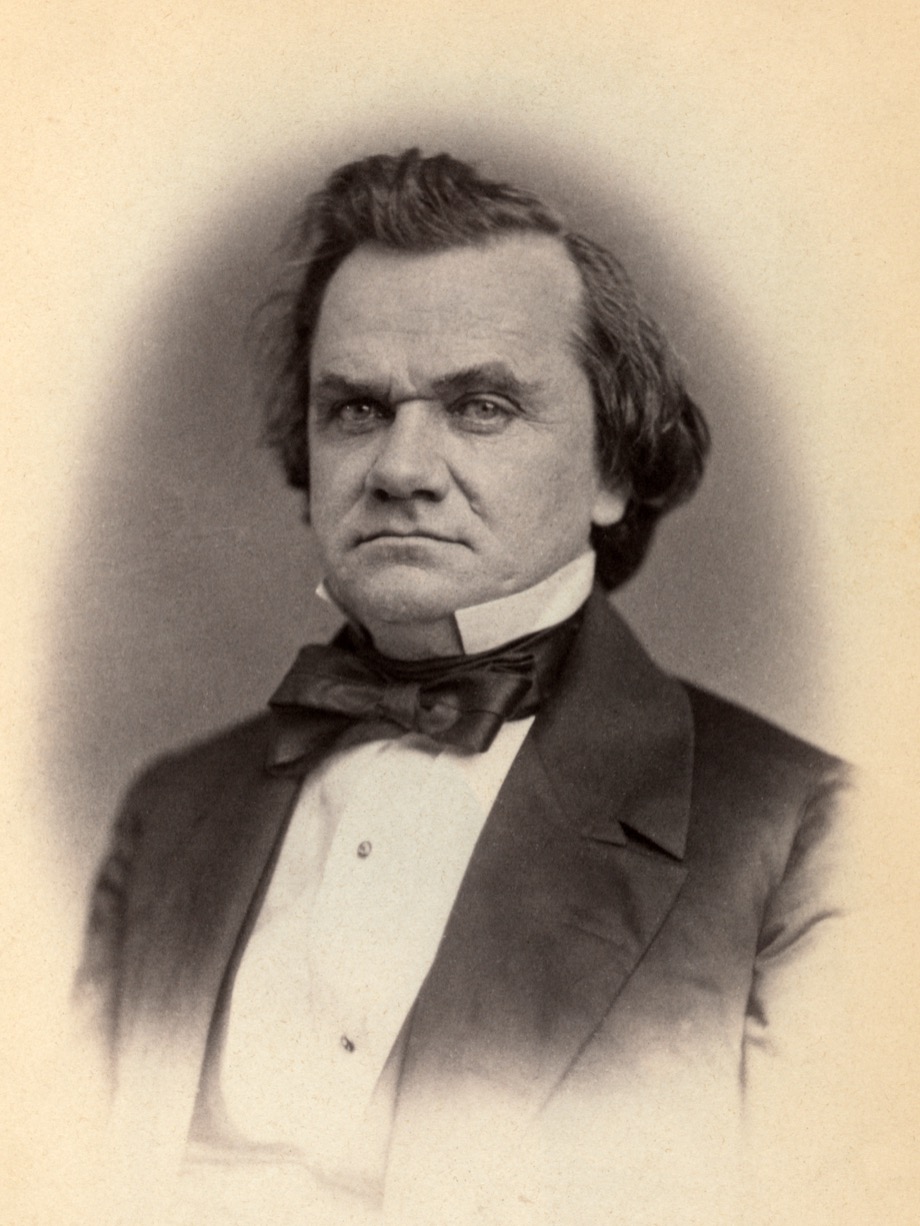
Portrait of Stephen A. Douglas
The Man Who Tried to Out-Clever a Moral Question
He stood barely five feet four inches, and for twenty years he was the loudest man in American politics. They called him the Little Giant — a nickname that began as a joke about his height and ended as a plain description of his weight in the Senate. Born in Vermont in 1813 and gone west to Illinois with no money and enormous nerve, Stephen Arnold Douglas wrote the bills, counted the votes, and chaired the Committee on Territories. He was also, by 1860, a man almost nobody fully trusted — and the reason is the most interesting thing about him.
Handed an intractable problem — the westward expansion of slavery, the question that would break the republic — he did not moralize and did not choose a side. He reframed. His signature invention, popular sovereignty, held that Congress should simply stop deciding: let the settlers of each territory vote the matter up or down for themselves. It was elegant, it was democratic, it dissolved two decades of failed legislation into a procedure — and it was a way of not answering.
That reflex toward a clever reframe rather than a fixed position is the fingerprint of a dominant-Ne mind, and Douglas is one of the cleanest ENTP specimens the nineteenth century produced. The Kansas-Nebraska Act of 1854 made the conviction law: it detonated the party system, filled Kansas with rifles, and created the coalition that would elect the man who beat him.
Douglas believed a clever enough procedure could substitute for a moral answer. The country spent seven years proving him wrong, and he spent his last three months admitting it.
Ne — The Reframe as a Weapon
Popular sovereignty was not a compromise in the ordinary sense. A compromise splits a difference; Douglas's doctrine erased the question and replaced it with a mechanism. Congress had spent thirty years drawing lines on maps, and every line failed because the underlying argument was moral and lines are not. Douglas produced a genuinely novel third option: don't decide, delegate. It is the characteristic dominant-Ne move, the sideways exit from a problem everyone else is pushing at head-on.
He deployed it with virtuosity. In 1850 he took Henry Clay's failed omnibus bill, broke it into separate measures, and passed them one at a time by assembling a different majority for each — the reason the Compromise of 1850 exists at all. In 1854 he bolted popular sovereignty onto a Nebraska railroad bill, repealing the Missouri Compromise almost as a technical consequence rather than a stated aim, apparently believing the repeal a formality since climate and soil would keep slavery off the plains anyway. He had modelled the politics and neglected the passions.
What followed was Bleeding Kansas — rival legislatures, stuffed ballot boxes, the sack of Lawrence, John Brown at Pottawatomie. The Whig party did not survive it; the Republican party was founded because of it. Douglas had produced an idea clever enough to reorganize American politics and had entirely failed to predict which way it would reorganize them.
Ti — The Freeport Doctrine, or Too Clever by Half
In 1857 the Supreme Court, under Roger B. Taney, ruled in Dred Scott that Congress had no power to bar slavery from a territory — which should have killed popular sovereignty outright, a territorial legislature being a creature of Congress. Douglas's answer, delivered at Freeport, Illinois in the second of his 1858 debates with Abraham Lincoln, is the purest specimen of his logic-machine we have. Slavery, he said, cannot exist a day without local police regulations to protect it; a territorial legislature that declines to pass those laws excludes slavery in fact, whatever the Court says about right.
It is airtight — a purely mechanical distinction between the legality of a thing and the enforceability of it, reconciling Court and doctrine without retreat from any position he had ever taken. That is auxiliary Ti doing exactly what it does: welding one of Ne's loose ideas into a structure that survives cross-examination.
Lincoln had asked the question precisely to force it. Douglas won the Senate seat and lost everything else. Southern Democrats heard the Freeport Doctrine as what it was: an instruction manual for nullifying their constitutional victory. Within eighteen months they had stripped him of his committee chairmanship and, at Charleston and then Baltimore in 1860, walked out of his convention rather than nominate him. He ran as a Northern rump candidate while the Southern wing backed Breckinridge separately; he carried one state, and Lincoln took the presidency with under forty percent of the vote. The most logically satisfying answer of Douglas's life was the one that destroyed him.
Fe — The Crowd, and the Last Three Months
Douglas read rooms the way other men read documents. The 1858 debates drew tens of thousands to small Illinois towns, and he pitched himself differently in each: in the southern counties he hammered racial demagoguery at Lincoln, in the northern ones he softened into the language of local self-government. That is tertiary Fe in its unlovely mode — the register adjusted to whatever the audience will swallow, and the least admirable thing about him.
It also produced something else. In 1860, having lost, he broke the convention that defeated candidates go quiet and campaigned south — into Alabama, Georgia, Tennessee — telling secessionist crowds to their faces that disunion was a crime and that he would hang any man who resisted federal authority. He knew the votes were gone. He went anyway.
At Lincoln's inauguration in March 1861 Douglas held his rival's hat. After Sumter he went to the White House, endorsed the call for troops, and made one last tour through Illinois; the Chicago speech of May 1 told Northern Democrats there were only patriots and traitors now. Typhoid killed him on June 3, 1861, at forty-eight — and the Democratic loyalists of the Northwest, the men who might have obstructed the war at its most fragile hour, had his last words ringing in their ears instead. Twenty years of enmity set down in weeks, because the situation had changed and he could see it.
Si — The Precedent He Could Not Feel
The Missouri Compromise had stood for thirty-four years. It was not merely a statute; by 1854 it was a settlement Northerners had grown up regarding as permanent. Douglas repealed it in a railroad bill, told colleagues the storm would blow over in a season, and then remarked that he could have travelled from Boston to Chicago by the light of his own burning effigies.
That is inferior Si with precision: no working sense of what accumulated practice weighs in other people's minds. To Douglas the 1820 line was an obsolete instrument that a better instrument superseded. To the country it was a promise, and breaking it proved that no promise about slavery would ever hold again. He could model interests brilliantly and could not model attachment at all.
The same blindness ran through his body. He drank hard and kept a pace that would have wrecked a larger man — the whole country by rail and steamboat through 1860, then the secession winter, then the war tour, coughing. The typhoid found a constitution with nothing left in reserve.
Why ENTP Over ENTJ
Why not ENTJ?
The Te-Ni executive builds toward a fixed objective and bends circumstances to reach it. Douglas worked the other way round: his genius was reactive — reading the room and constructing a new frame or a procedural dodge in real time. Popular sovereignty was not a plan for an outcome but a device for avoiding commitment to any outcome, which is precisely what an ENTJ would have had no use for. An ENTJ in his seat would have picked a side, accepted the smaller coalition, and driven it; and no Ni-directed strategist blurts out the Freeport Doctrine on a debate platform in front of the Southern press.
The tell is the shape of his failures. ENTJs lose by overreaching toward a goal; Douglas lost by being too ingenious in the moment. He never lacked nerve, but he lacked a destination — twenty years of enormous energy spent keeping a coalition intact rather than on anything the coalition was for. When the improvisations ran out in 1861, an ENTJ's ego would have been welded to two decades of position; Douglas dropped the whole architecture and went to work for the man who had beaten him. Flexibility that total is not strategy. It is Ne, finally aimed at something worth aiming at.
Connected Figures
Further Reading
- Stephen A. Douglas — Robert W. JohannsenThe standard full-scale biography — exhaustive on the legislative craftsmanship and unusually fair to Douglas's own view of what he was doing.
- Lincoln and Douglas: The Debates that Defined America — Allen C. GuelzoReconstructs the 1858 campaign debate by debate, including the Freeport exchange and how differently Douglas pitched himself north and south.
- The Impending Crisis: America Before the Civil War, 1848–1861 — David M. PotterThe classic account of the road to secession; the chapters on Kansas-Nebraska and the 1860 conventions are the best treatment of how Douglas's cleverness broke his party.
- The Political Crisis of the 1850s — Michael F. HoltArgues the party system's collapse, not slavery alone, produced the war — the structural frame within which Douglas's coalition-holding makes sense.
- Battle Cry of Freedom: The Civil War Era — James M. McPhersonOne-volume standard; places Douglas's final Union tour and death in the broader mobilization of the North.
