 Historical Figure MBTI
#649 · 5-12-26 · The Julio-Claudians
Caligula
The Boy Emperor · Cruelty as Spectacle · A Reign the Sources Hated
12 — 41 CE
10 min read
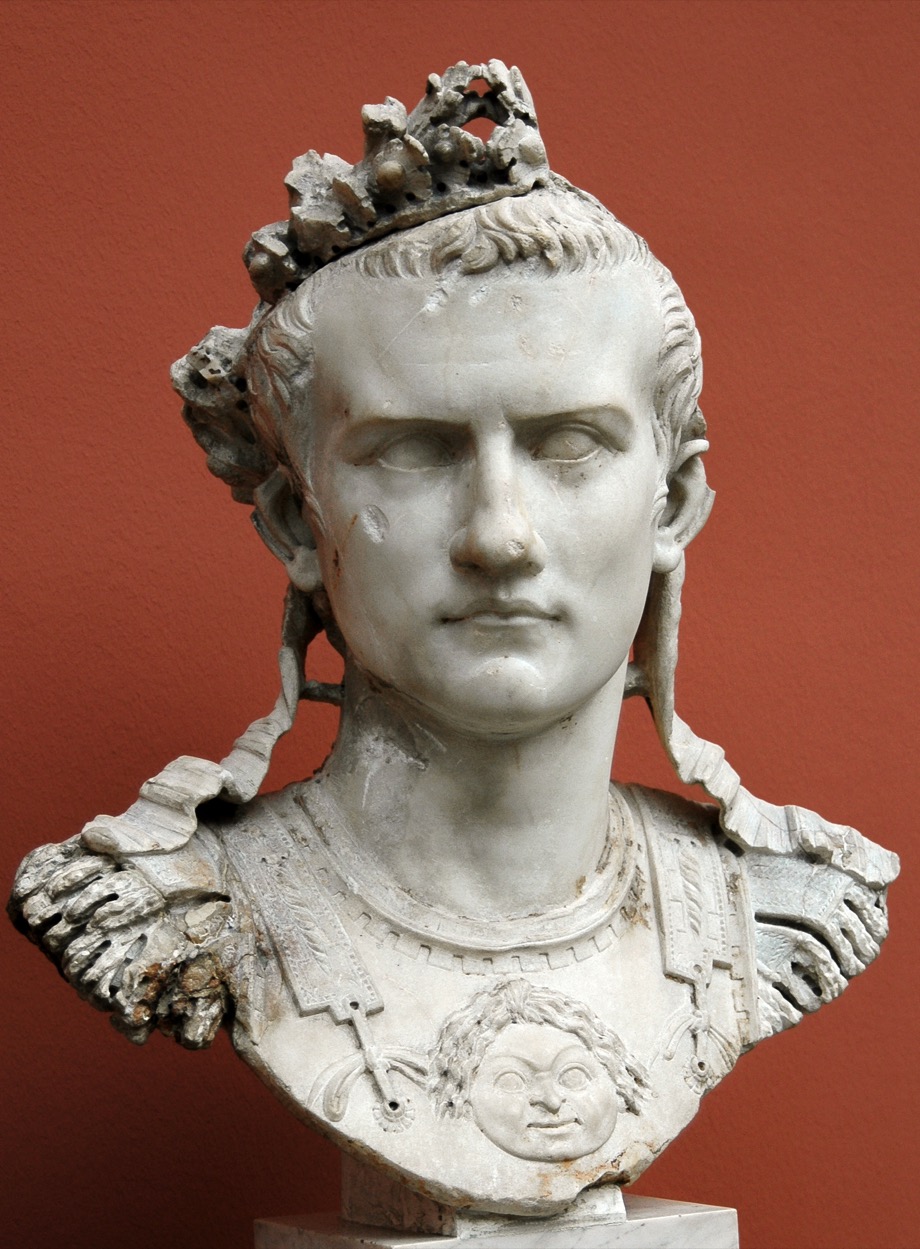
Portrait of Caligula
Little Boots, No Ballast
He was raised in the camps, dressed as a miniature legionary and paraded before the troops of Germanicus until the soldiers themselves coined his name: Caligula, "little boots." It is a fitting origin for a man who would spend a lifetime performing for an audience rather than governing one. By the time he took the throne in 37 CE at twenty-four, he was the last adult male standing in a family Tiberius had spent a decade dismantling — his father poisoned or cursed to death in Antioch, his mother and elder brother starved and hounded to suicide, his own childhood a masterclass in watching who disappeared next and saying nothing about it. Rome received him as a deliverance. Suetonius says the crowds who greeted his accession called him "star" and "chick" and "baby" — the empire's collective sigh of relief after the paranoid last years of Tiberius.
What the sources describe next is not a program but a sequence of performances, each more theatrical than the last, none of them adding up to a system. A near-fatal fever seized him seven months into the reign — Suetonius calls it a brain fever, and both ancient and modern writers have argued for decades over how much of what followed can be laid at illness's door. What is harder to dispute is the shape the behavior takes, illness or no illness: sudden reversals, sensory extravagance, humiliations improvised on the spot rather than plotted in advance. He bankrupted a treasury Tiberius had left overflowing, not on infrastructure or conquest but on games, banquets, and a pontoon bridge across the Bay of Baiae built, by his own account, so he could ride a horse across water like a god. It reads less like tyranny with a plan than like appetite without brakes — the record, read carefully, of a man whose gift was for the immediate and vivid and whose blind spot was for anything requiring patience.
That combination — a hunger for sensation married to almost no capacity for long design — is the signature of ESTP, dominant Extraverted Sensing. Caligula's cruelty, on the evidence we have, was rarely calculated; it was staged, moment to moment, for effect.
Caligula did not build a tyranny. He improvised one, scene by scene, the way an ESTP improvises everything — living entirely in the vivid present, with no durable plan behind the spectacle.
War on the Sea, Spoils of Shells
Nothing in the hostile record captures dominant Se better than the campaign against Neptune. Marching legions to the Channel coast, allegedly for an invasion of Britain, Caligula instead had the men line up facing the water, ordered them to gather seashells into their helmets, and declared them spoils of a war won against the god of the sea. Historians have argued the episode may be a garbled account of a genuine, more mundane military exercise — but the fact that it took root as *the* defining Caligula story tells you what kind of ruler the Roman imagination believed him to be: one who acted first, dramatically, and let meaning arrive after the fact, if at all.
The pattern recurs everywhere sensation could be maximized. He forced senators — men of consular rank — to run for miles alongside his chariot in their togas. He reportedly threatened, perhaps only in a joke that outlived its context, to make his racehorse Incitatus a consul: the horse had a marble stable, ivory manger, and a jeweled collar, an act of provocation aimed less at governance than at watching powerful men swallow the insult. Bridge-building across the Bay of Baiae, gladiatorial games run at obscene expense, temples raised to his own divinity — each is a set piece, built for the moment of spectacle, not for what it would cost the treasury six months on.
Even the incest accusations lodged against him — a relationship alleged with his sister Agrippina the Younger, less credibly with Julia and Drusilla — fit the same register in the sources: transgression performed in the open, daring the world to react, rather than concealed as a private vice. Whatever the truth beneath Suetonius's gossip, the shape of the accusation itself is telling. This was not a man remembered for secrecy. It was a man remembered for showing you exactly what he was doing while he did it.
A Sharp, Cold Logic for the Kill
What kept Caligula from being merely a spoiled boy with an army was a real, if narrow, analytical edge — auxiliary Ti applied in flashes, almost always to expose or dismantle rather than to build. Cassius Dio and Suetonius both record him as an unexpectedly capable and cutting speaker, quick with legal argument and public reasoning when it suited him. He understood, with real precision, exactly which levers of Roman law and status could be turned against the senatorial class that had tolerated his family's destruction under Tiberius, and he pulled them with visible relish — reviving treason trials, forcing self-incriminating confessions, needling the Senate's pretensions to independence in public.
This is Ti in its coldest, most detached register: logic as scalpel, not as architecture. He could reason his way, in the moment, to precisely the humiliation that would land — a joke about a senator's baldness, a demand that reveals a man's cowardice, a legal technicality exploited for maximum public sting. What he could not do, and what separates him from a genuinely strategic tyrant, is use that same faculty to construct anything that would outlast the performance: no new bureaucratic apparatus, no lasting reform of the succession, no systematized machinery of terror comparable to what more calculating rulers elsewhere in Roman history managed to build and sustain.
The logic served the spectacle, not the other way around. It sharpened the blade for each individual scene; it never assembled the scenes into a plan.
The Crowd He Never Stopped Courting
Tertiary Fe shows up not as warmth but as an acute, restless sensitivity to how he was being watched — and a real early talent for reading a crowd. His accession was a genuine popularity triumph: he canceled Tiberius's treason trials, paid promised bequests, staged games the public adored, and for months was, by the sources' own admission, beloved. That opening act required something more than sensation-seeking; it required an instinct for what a mass audience wanted to feel about its emperor, and the social fluency to deliver it.
But Fe under an ESTP stays in service of the immediate scene rather than any durable relationship, and the record shows the instinct curdling into theater once popularity alone stopped being enough of a thrill. He needed reaction, not connection — the humiliated senator's face, the crowd's shocked gasp at some fresh extravagance, the value of a spectacle rising with how visibly it wounded or dazzled. Compare this to Nero, an ESFP a generation later, whose performances were driven by a hunger to be loved and admired for his art, chasing feeling for its own sake even at the cost of the empire's patience. Caligula's performances chase a different reward: dominance over the room, proof that the audience cannot look away, cannot refuse, cannot do anything but watch him do the unthinkable.
It is Fe in an unhealthy loop — attuned to the audience, dependent on it, but incapable of building the kind of reciprocal loyalty that might have protected him when the audience turned. And the Praetorian Guard turned.
No One Was Watching the Door
The single clearest fact of Caligula's death is that he did not see it coming, and by every account should have. He had spent four years accumulating enemies with no regard for what they might eventually do about it — humiliated senators, threatened officials, a Praetorian Guard whose own officers he had mocked and endangered. An inferior Ni ruler under this kind of sustained provocation shows almost no capacity to project the trajectory forward, to ask what happens after the scene ends. Tiberius, whatever his cruelties, had spent years engineering his own security through calculated isolation on Capri. Caligula walked corridors alone, unguarded, still performing.
In 41 CE, officers of his own guard cornered him in a palace passageway after a theatrical performance and stabbed him to death — the first Roman emperor murdered by the men sworn to protect him. His uncle Claudius, found afterward cowering behind a curtain, was made emperor by the same guard almost by accident, an outcome no one — least of all Caligula — had planned for. The lack of foresight is not incidental to the story; it is the story. A ruler with functioning Ni, even a tyrannical one, insures against the obvious threat. Caligula never did, because insuring against a future threat requires living somewhere other than the vivid, satisfying present.
Here the case for restraint in reading Caligula matters most. Suetonius wrote decades later for readers who wanted their tyrants monstrous; Cassius Dio wrote further out still, compiling secondhand horror stories with a senatorial class's grudge against any emperor who mocked the Senate. Both had reason to blacken him, and neither witnessed the reign firsthand. The fever of 37 CE — a documented, serious illness — may have altered his temperament in ways no contemporary understood, medically or otherwise. What can be said with more confidence than any single anecdote is the shape underneath the anecdotes: impulsive, present-tense, escalating action with no strategic follow-through, whatever the exact cause. That shape is ESTP pushed to its most self-destructive extreme, not a mastermind's design.
Why ESTP Over ENTJ
Why not ENTJ?
An ENTJ tyrant builds — durable institutions of control, a succession plan, a bureaucracy that outlives the man at the center of it. Nothing in Caligula's reign does that. He drained a full treasury on games and monuments with no strategic return, declared farcical war on the sea and had troops collect seashells as spoils, and allegedly floated making his horse a consul purely to watch the Senate flinch — provocation as its own reward, not a step toward anything. An ENTJ escalates toward a goal; Caligula escalated toward the next sensation, with no goal visible behind it and no defense prepared for the predictable backlash that killed him.
The distinction matters because Rome had already seen calculating tyranny, in Tiberius's patient, paranoid purges, and would see organized state terror again later in the dynasty. Caligula's reign reads differently in the sources: not a machine but a series of scenes, each vivid, none connected to the last by any plan longer than an afternoon. That is ESTP's signature failure mode when handed absolute power and no one left who can say no to it.
Connected Figures
Further Reading
- The Twelve Caesars — SuetoniusThe primary hostile-source account of Caligula's reign, written decades later for a scandal-hungry readership.
- Roman History — Cassius DioA second senatorial-class source, compiled generations after the events, useful mainly for corroborating patterns rather than specific anecdotes.
- Caligula: The Corruption of Power — Anthony BarrettA modern biography that carefully separates plausible fact from Suetonian embellishment.
- Caligula: A Biography — Aloys WinterlingArgues much of the 'madness' reflects a deliberate, if reckless, political strategy misread by hostile sources — a useful counterweight to read against this entry's own conclusions.
