 Historical Figure MBTI
#1181 · 8-29-26 · The Three Kingdoms
Cao Ren
The Iron Wall of Fan Castle · Cao Cao's Cousin and Shield · Defender Against Guan Yu's Flood
168 — 223
5 min read
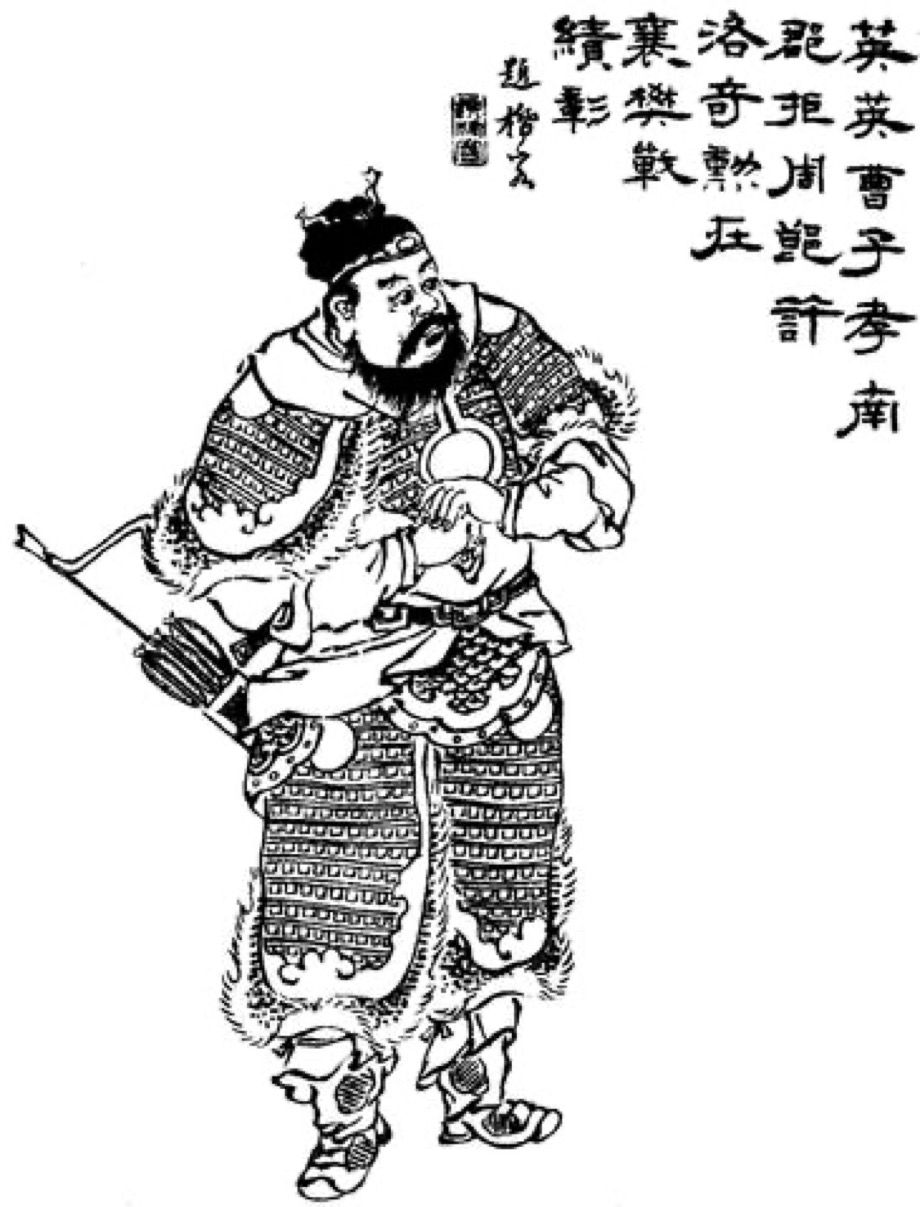
Portrait of Cao Ren
The Wall That Would Not Move
Every dynasty needs a founder who dreams and a cousin who holds the line while the dream is still unfinished. Cao Cao supplied the vision, the ruthlessness, the poetry. Cao Ren supplied the thing visions actually depend on and rarely get credit for: a garrison that does not break. Twice in his career, at moments when the Wei cause could plausibly have ended, Cao Ren was handed an indefensible position and told, in effect, to make it defensible by refusing to leave it. Twice he did.
The first time was Jiangling, in the ruin of Red Cliffs, with Zhou Yu's fleet at the gates and Cao Cao's main army in retreat a thousand li away. The second was Fan Castle, two decades later, with Guan Yu's engineered floodwaters lapping at the ramparts and half the garrison's shelter already underwater. Neither siege was won by inspiration. Both were won by a commander who treated the order to hold as a fact of nature rather than a proposal to be reconsidered, and who kept his men fed, drilled, and disciplined long enough for someone else's relief column to arrive. That is the entire portrait of an ESTJ: command exercised outward, in the open, under a clock that is always running out.
Cao Ren's ESTJ is not the ISTJ virtue of quiet compliance — it is Te seized in both hands, a man who commands a besieged city rather than merely enduring inside one.
Command Under a Deadline
At Jiangling in 208–209, Cao Ren inherited the wreckage of Red Cliffs: a demoralized army, a riverine city exposed on every side, and an enemy commander, Zhou Yu, who had just proven himself the single most dangerous strategist south of the Yangtze. There was no clever countermove available to him — no flanking maneuver, no diplomatic trick. There was only the work of organizing a city under siege for nearly a year: rationing, wall repair, troop rotation, the grinding administration of not losing. He held it until the position's cost outweighed its value, then withdrew on his own terms rather than being routed, buying Cao Cao the better part of a year to rebuild in the north.
Fan Castle in 219 asked more of him. Guan Yu did not merely besiege the city — he diverted the Han River into it, turning the surrounding plain into a lake and the garrison into something closer to a shipwrecked crew than an army. Officers around him argued for evacuation; the position, by any reasonable measure, was lost. Cao Ren's response was pure Te: he assessed what remained operationally rather than what had been lost strategically, and concluded the walls still stood, the men could still fight, and abandoning the city would hand Guan Yu a base from which to gut Wei's entire southern front. He held. That single refusal — not a plan, a refusal — is what gave Xu Huang's relief force and Lu Meng's rear-guard strike against Guan Yu the time they needed to turn the campaign, and it cost Guan Yu his life.
Discipline as a Standing Procedure
Cao Ren was, by every surviving account, a strict and sometimes harsh disciplinarian — a commander who ran his garrisons on procedure rather than charisma, and who was more feared than loved by the men under him. That is Si in its least sentimental form: a trust in established method, precedent, and routine so total that it becomes a kind of armor. Where a more improvisational commander might have gambled on a sortie or a night raid to break either siege, Cao Ren's instinct ran the other way — toward rationing schedules, watch rotations, wall inspections, the unglamorous machinery that keeps an army functioning past the point where morale alone would have collapsed it.
This is also, not incidentally, what made him the right man to place under Cao Cao rather than beside him. Cao Cao improvised brilliantly and paid for it at Red Cliffs; Cao Ren's entire military identity was the opposite bet — that a position held by the book, with enough supplies and enough order, will outlast an opponent's cleverness. At Fan Castle that bet very nearly failed against nature itself, but the discipline that kept the garrison intact through a flood is the same discipline that kept Jiangling intact through a siege a decade earlier. It was never a new trick. It was the same trick, applied with total consistency.
Why ESTJ Over ISTJ
Why not ISTJ?
An ISTJ garrison commander would execute someone else's defensive plan with quiet, inward competence. Cao Ren's Te is outward-facing and command-oriented: he actively organizes and directs an entire besieged city under visible pressure, issuing orders, allocating supplies, and holding named theater command rather than occupying a subordinate role within it. The Jiangling and Fan Castle sieges were not tasks assigned to him and performed correctly — they were commands he ran, at the scale of a whole defended city, with the authority and the visible decisiveness that mark Te as dominant rather than supporting.
The distinction matters because Cao Ren's reputation could easily be flattened into mere stubbornness — the man who simply would not leave. But stubbornness alone does not organize a year-long siege or hold a flooded fortress together as a functioning military unit. That takes an active, directing intelligence imposing order on chaos in real time, which is Te's signature, laid over an auxiliary Si that supplies the procedural memory and discipline to sustain it. ESTJ is the only type that produces both halves of that portrait at once.
Connected Figures
Further Reading
- Records of the Three Kingdoms — Chen ShouThe primary biography of Cao Ren, covering Jiangling and Fan Castle.
- Imperial Warlord — Rafe de CrespignyA study of Cao Cao's court and generals, including Cao Ren's role in Wei's founding campaigns.
- A Biographical Dictionary of Later Han, Three Kingdoms and Jin — Rafe de CrespignyReference entries on Cao Ren, Guan Yu, and the Fan Castle campaign.
