 Historical Figure MBTI
5 min read
#89 · 3-4-26 · The Founding Generation of USA
Catherine Van Rensselaer Schuyler
American aristocrat, estate manager, and matriarch of one of the most influential families of the Revolutionary generation.
1734 — 1803
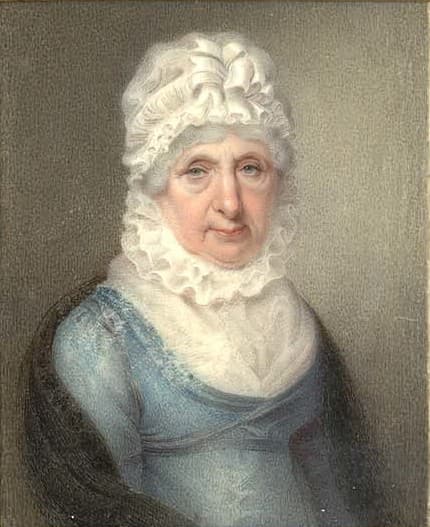
Portrait of Catherine Van Rensselaer Schuyler.
The Administrator of the Schuyler Household
Born in 1734 in colonial New York, Catherine Van Rensselaer Schuyler belonged to the powerful Van Rensselaer family, one of the wealthiest landholding dynasties in the Hudson River Valley. Her marriage in 1755 to Philip Schuyler united two of the most influential families in the region and created a household that would become a central political and military hub during the American Revolution.
While Philip Schuyler operated in the worlds of military command and public politics, Catherine presided over the vast domestic institution that sustained the family’s influence. The Schuyler estate in Albany was not merely a private home. It functioned as a logistical and social center where officers, politicians, and diplomats frequently gathered during the war.
Managing such an environment required extensive organization. Catherine oversaw the estate, coordinated household staff, supervised food supplies and operations, and maintained the stability of the household while her husband spent long periods away in military service.
Visitors to the Schuyler home included figures such as George Washington, Benjamin Franklin, and the young Alexander Hamilton, who would later marry her daughter Elizabeth Schuyler Hamilton.
The household itself functioned almost like a command center of the northern revolutionary network.
Catherine also demonstrated decisive leadership during wartime danger. Local accounts recount that when enemy forces threatened the Albany region, she ordered nearby wheat fields burned to prevent them from being used to supply British-aligned troops.
Her life therefore combined the responsibilities of estate management, wartime resilience, and family leadership. Together with Philip Schuyler she raised eight children, including Angelica Schuyler Church and Elizabeth Schuyler Hamilton, both of whom became prominent figures within the political society of the early United States.
Though she did not hold formal political office, Catherine played a crucial role in sustaining the environment that allowed the Schuyler family to operate at the center of revolutionary leadership.
The Psychological Verdict
Catherine Van Rensselaer Schuyler is best understood as ESTJ.
Historical descriptions emphasize her decisiveness, administrative capability, and responsibility for maintaining a large estate and social household during a period of political upheaval. Her influence centered on organization, duty, and the stability of the systems surrounding her family.
These patterns align closely with the Te–Si cognitive framework.
Rather than shaping the Revolution through ideology or battlefield command, Catherine’s influence lay in maintaining the operational structure that supported the political and military leadership of her household.
Te — dominant
Catherine’s leadership of the Schuyler estate reflects the strengths of dominant Extraverted Thinking (Te).
Running an eighteenth-century estate required managing staff, coordinating supplies, organizing guests, and maintaining daily operations across a large property. During the Revolutionary War these responsibilities became even more complex as the household regularly hosted military officers and political leaders.
Her ability to maintain order and functionality in this environment demonstrates a strong orientation toward practical organization and execution.
The Schuyler household functioned effectively because someone ensured that its systems worked.
Catherine filled that role.
Si — auxiliary
Her leadership also reflected strong Introverted Sensing (Si).
Catherine maintained the traditions, routines, and stability of the household even during the upheaval of war. The estate remained a reliable center of hospitality and coordination throughout the Revolutionary period.
Si-supported personalities often act as stewards of continuity, preserving the structure of family and community life during uncertain times.
Catherine’s household became exactly such a stable institution.
Ne — tertiary
Though grounded in structure and responsibility, Catherine also demonstrated openness to new individuals entering the family’s world.
The arrival of Alexander Hamilton into the Schuyler household illustrates this flexibility. As a young officer of modest background, Hamilton might easily have remained socially distant from elite New York families.
Instead, he became part of the Schuyler family through his marriage to Eliza.
This willingness to incorporate rising figures into the household network reflects the influence of tertiary Extraverted Intuition (Ne).
Fi — inferior
Despite her practical administrative focus, Catherine appears to have possessed a strong sense of personal loyalty and family responsibility.
Her decisive actions during wartime threats and her dedication to protecting the estate reflect an internal commitment to the well-being of her family and community.
This quiet but powerful moral grounding reflects the influence of inferior Introverted Feeling (Fi), expressed not through public declarations but through steadfast duty.
The Household Command Center
Together, Philip and Catherine Schuyler created one of the most influential households of the Revolutionary era.
Philip built military and political systems.
Catherine ensured that the institution supporting those systems functioned smoothly.
Within that environment, the Schuyler family became deeply connected to the leadership of the early United States.
The Revolution produced generals, statesmen, and political thinkers.
But it also required homes that operated with discipline, stability, and coordination.
Catherine Schuyler ran one of them.
Connected Figures
Further Reading
- Alexander Hamilton — Ron Chernow (2004)The definitive biography — extensively covers the Schuyler household and Catherine's role as matriarch of Hamilton's adoptive family.
- My Dear Hamilton: A Novel of Eliza Schuyler Hamilton — Stephanie Dray & Laura Kamoie (2018)Historical fiction grounded in primary sources; illuminates the Schuyler family dynamic, including Catherine's influence on her daughters.
- The Schuyler Sisters — Wayne Andrews (1939)An early group biography focused on the three famous daughters, situating Catherine as the household center they all grew up within.
