 Historical Figure MBTI
#261 · 3-25-26 · Catherinian Russia
Constantine Pavlovich
Grand Duke · Soldier · The Brother Who Refused the Crown
1779 — 1831
5 min read
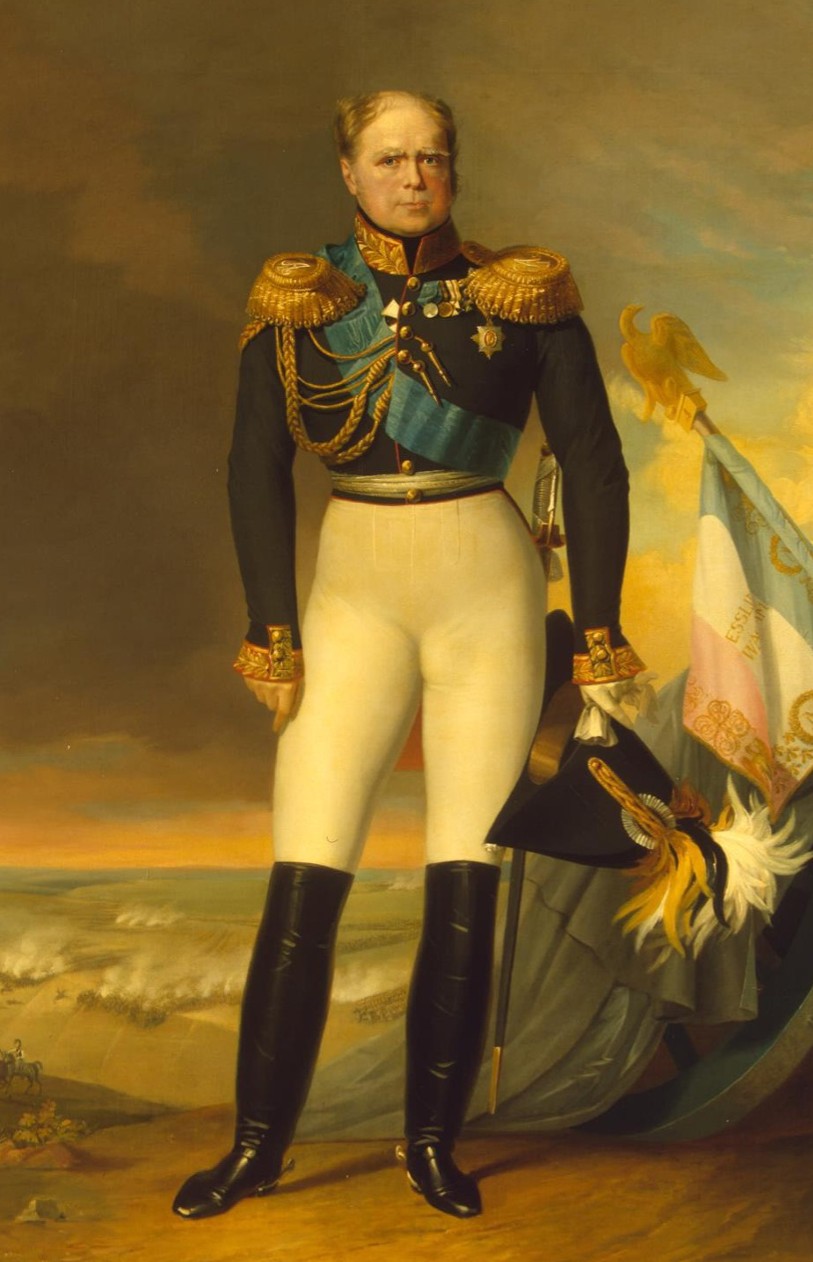
Portrait of Constantine Pavlovich
The Heir Who Wanted Only a Horse and a Parade Ground
He was born in 1779 into the largest inheritance in Europe and spent his whole life trying to give it away. Catherine the Great named her second grandson Constantine for the restored Byzantine empire she meant to carve from the Ottomans and crown him in Constantinople. What she got was a coarse, hot-tempered soldier who could not sit through a court ceremony without fidgeting, who loved the smell of gunpowder and the crack of the drill ground, and who said, repeatedly and with feeling, that he would rather be strangled than rule Russia.
He became viceroy of Poland after 1815, fell in love with the Polish countess Joanna Grudzińska, and contracted a morganatic marriage that disqualified any heir. Then he quietly, secretly renounced his right to the throne. That renunciation, hidden in sealed envelopes, detonated when Alexander I died in December 1825. For three weeks Russia had no certain tsar. Into the vacuum marched the Decembrists shouting for “Constantine and Constitution” — some reportedly believing “Constitution” was his wife's name. The man they cheered was in Warsaw, refusing to come. The psychology underneath is the ESTP: a sensation-driven man of action who lived in the immediate physical present and could not be made to want the one thing the world insisted he must want.
Constantine was the ESTP handed an empire and asking only for a parade ground—a creature of the concrete moment who fled the throne not from humility but because a crown is an abstraction, and he trusted only what he could ride, drill, and feel under his hands.
The Man Who Lived in His Hands
Se — dominant
Dominant Se is total absorption in the physical present. Constantine loved the army not as an institution to administer but as a sensory world to inhabit: the snap of a perfectly aligned rank, the weight of a saber, the dust of the drill field. He could spend whole mornings correcting the angle of a soldier's elbow. He swore, mocked etiquette, and preferred grooms to ambassadors — Se reads ceremony as friction, and he wanted contact, not pageantry. His courage under Suvorov in 1799 was Se courage: not calculated bravery but the instinct of a man who feels most alive under fire. His rages were the same function discharged without a filter — sudden, violent, and then gone, the storm passing clean through him. He felt the provocation, exploded, and moved on.
The Logic of the Drill Manual
Ti — auxiliary
Auxiliary Ti gives the ESTP a working framework applied with mechanical precision to whatever the dominant function is gripping. In Constantine it expressed itself as an obsession with military regulation — he knew the drill manual down to every spacing and angle. His tyranny over the Polish army was not cruelty for its own sake but intolerance of any deviation from the exact specification. He distrusted the liberal abstractions of the Decembrists — constitutions, rights of man — not from political conviction but because his Ti could find no concrete mechanism to test against experience. Sharp on the parade ground, clumsy in the council chamber, almost entirely blind to the question of who would inherit Russia.
The Soldiers' Favorite and the Countess
Fe — tertiary
Tertiary Fe shows up as warmth that surfaces unpredictably between long stretches of obliviousness. The rank-and-file soldiers loved Constantine; he was, for all his brutal drilling, one of them in a way the cold and ceremonious Nicholas never was. The morganatic marriage to Joanna Grudzińska is the clearest evidence of tertiary Fe overriding everything else: he fell in love, divorced his first wife, and married beneath his station knowing it cost him any legitimate heir. The one decision made with his heart was a decision against the throne. But the same Warsaw soldiers who admired his bluntness suffered his caprices. He could read a room of soldiers; he could not read a nation.
The Throne He Could Not See
Ni — inferior
Inferior Ni is the ESTP's blind spot: the long view, the symbolic meaning, the converging future an Ni-dominant grasps almost without effort. A crown is the most abstract of possessions — a symbol, a destiny, a meaning projected across generations. It was exactly the kind of thing Constantine's mind could not hold, and he recoiled from it the way an ESTP recoils from any demand to live for a future he cannot touch.
His secret renunciation is inferior Ni at its most destructive. A man with developed intuition would have foreseen the catastrophe of an unpublicized abdication — grasped that legitimacy cannot survive ambiguity, that sealed envelopes are not a tidy private arrangement but a loaded gun left on the table. Constantine handled the most consequential symbolic question in the empire — who is the tsar? — as if it were a private matter he could settle by simply declining and walking away. The result was the three-week interregnum, the confusion that let the Decembrists raise their regiments on Senate Square, and the bloodshed that Nicholas I used to crush them. The deepest irony: named for the grandest Ni vision of the age — Catherine's dream of a reborn Byzantium — he grew up unable to imagine his own succession three weeks ahead.
Why ESTP Over ISTP
Why not ISTP?
The ISTP shares Constantine's Se–Ti spine but leads with introverted thinking and turns the sensory world inward — the detached craftsman who withdraws rather than performs. Constantine was loud, public, eruptive, visibly energized by an audience of soldiers. His rages were theatrical, his temperament that of a man who needed to be in the middle of the action. That is dominant Se, not dominant Ti. His catastrophic blind spot was intuitive — his inability to see the symbolic consequences of his hidden renunciation — which places his inferior function squarely as Ni. He is the ESTP.
Connected Figures
Further Reading
- The Romanovs: 1613 — 1918 — Simon Sebag MontefioreThe broadest account of the dynasty, with substantial coverage of Constantine's role in the 1825 succession crisis and his years as viceroy of Poland.
- The Decembrist Movement — Marc RaeffA foundational study of the 1825 revolt and its officers — the event Constantine's hidden abdication made possible.
- Russia in the Age of Alexander I — Janet M. HartleyPlaces Constantine's military career and Polish viceroyalty in the broader context of the reign he nominally stood to inherit.
- Nicholas I: Emperor of All the Russias — W. Bruce LincolnExamines how Nicholas consolidated power in the aftermath of the Decembrist rising — the crisis Constantine's renunciation made possible.
