 Historical Figure MBTI
#260 · 3-25-26 · Catherinian Russia
Nicholas I
Tsar · Iron Autocrat · Gendarme of Europe
1796 — 1855
6 min read
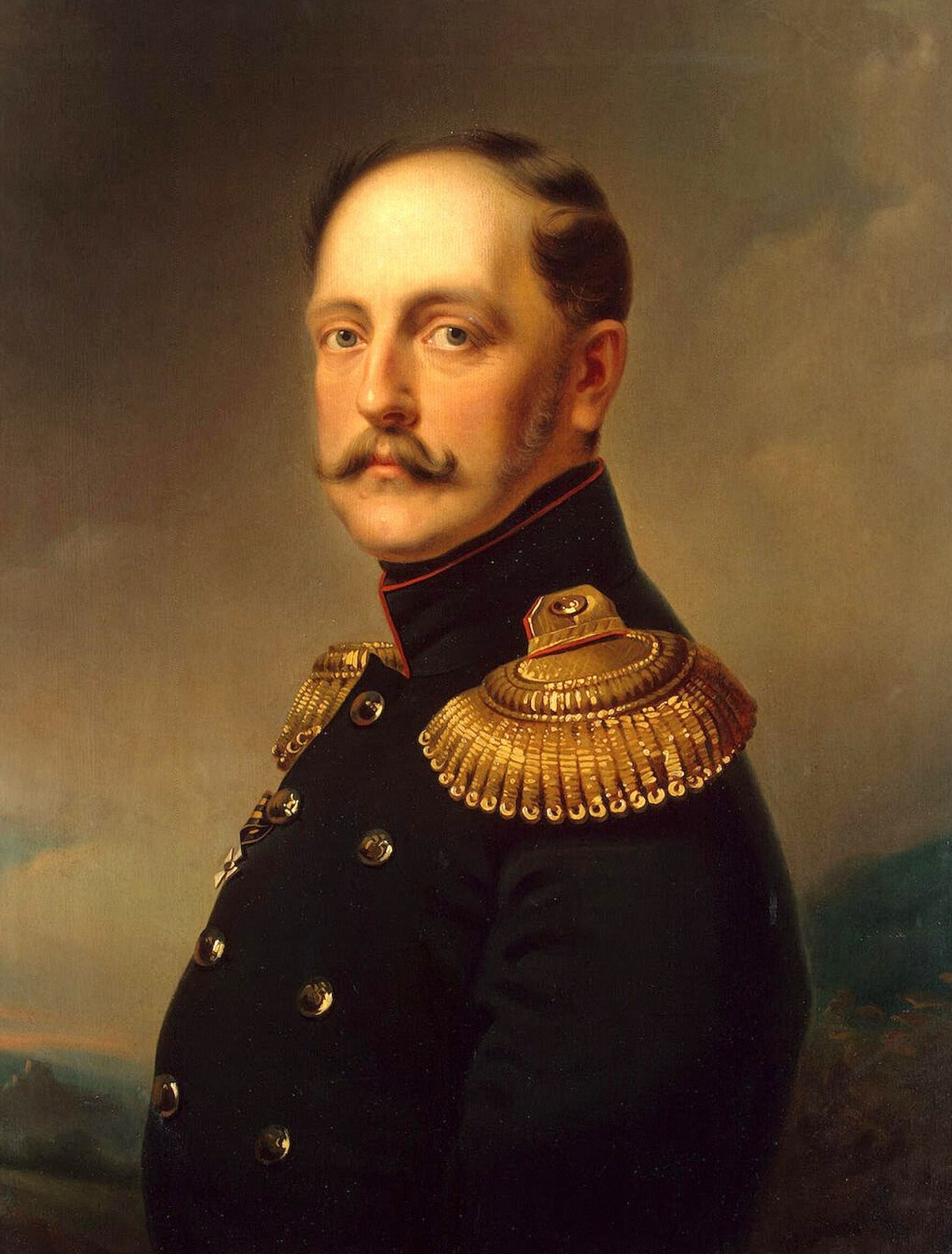
Portrait of Nicholas I
The Engineer of Order
On December 14, 1825, Nicholas stood in Senate Square facing mutinous soldiers. He had been tsar for less than a day, had not been raised to rule, and had taken the crown only because his brother Constantine, next in line after the childless Alexander I, had secretly renounced it. When the confusion resolved, the Decembrists seized the moment. Nicholas ordered the artillery to fire. The bodies went under the ice. It would be the shape of everything that followed.
Everything that followed was an attempt to ensure December 14 could never recur. He built the apparatus that would define Russian autocracy for thirty years: the Third Section, a suffocating censorship regime, and an ideology compressed into three words—Orthodoxy, Autocracy, Nationality. He was not a tyrant of appetite. He was a ISTJ who believed order was the highest good, and who broke himself against a century that had stopped agreeing.
Nicholas I was the ISTJ raised to the scale of an empire—a man who mistook the perfection of order for the meaning of governance, and who served duty so faithfully that he could not see when duty had led him to ruin.
The Weight of How Things Are Done
Si — dominant
Dominant Si trusts what has been tested by time. Nicholas was raised by military tutors and took to the parade ground with a passion that never left him. He loved engineering and fortification: disciplines where the right answer is fixed and error is visible. The drill, the inspection, the immaculate column were not pedantry but visible proof that the world was behaving as it should.
His response to the Decembrist revolt was pure Si: not what social forces were gathering, but how the breach had occurred and how to seal it permanently. The Third Section compiled exhaustive reports on the country's mood, as if an empire could be inventoried like a quartermaster's stores. He accumulated more detail about his realm than any tsar before him—and understood it, in the end, less.
The Bureaucracy as Instrument
Te — auxiliary
Nicholas's great monument was a book: the Complete Collection of the Laws of the Russian Empire—forty-five volumes of every statute since 1649, followed by a Digest giving Russia its first coherent legal code. He governed through personal bureaus answering directly to the throne, bypassing ordinary state machinery and routing authority where the executive could command it.
But auxiliary Te optimizes the system it inherits rather than questioning whether the system should exist. Nicholas used his apparatus to preserve serfdom—an institution he privately knew to be a disaster. He convened secret committee after secret committee, generated mountains of reports, and changed almost nothing. His Te made the autocracy run with unprecedented efficiency; it could not make the autocracy ask whether it was running toward a cliff.
The Private Code of Honor
Fi — tertiary
Tertiary Fi does not produce warmth; it produces a private code. Nicholas believed himself bound by sacred trust to preserve the autocracy—not as ambition but as obligation. He found power a burden he could not honorably refuse. When magnificence was on display, it was the state's; the man slept on a camp bed.
But tertiary Fi has a narrow aperture. Nicholas's honor extended to his conception of his role, almost never to those his role affected. He could order grapeshot into his own guardsmen and condemn Dostoevsky to a mock execution without violating his code, because the code was about duty to the office, not empathy for the person—a man of conscience who could be, by that very conscience, merciless.
The Future He Could Not Imagine
Ne — inferior
Inferior Ne is the ISTJ's blind spot—the inability to see emerging possibilities. Nicholas's reign was a war against the new, fought by a man who could not conceive it might be inevitable. The revolutions of 1830 and 1848 were contagions to quarantine; he sent troops to crush the Hungarian revolution of 1849 rather than ask what force was moving Europe—earning him “gendarme of Europe.”
His diplomacy assumed the Holy Alliance of 1815 still bound the courts of Europe long after the assumption had gone hollow. He believed his army the finest in Europe because it drilled beautifully; he could not imagine that smooth-bore muskets facing rifles would matter more than parade-ground perfection. He had spent thirty years perfecting answers to questions that had changed.
Why ISTJ Over ESTJ
Why not ESTJ?
The temptation is to read Nicholas as an ESTJ: the natural commander who imposed order on a continent. But the ESTJ leads with extraverted thinking—energized by directing people and engaging the world as its primary arena. Nicholas was not that man. He was solitary, austere, and inward; he distrusted the social world rather than commanding it with relish. His Te was real but auxiliary—a tool in service of a deeper, private conviction. The ESTJ organizes because it loves to organize; Nicholas organized because duty left him no choice. Dominant Si, not dominant Te, makes him ISTJ.
The distinction explains the texture of his rule. Nicholas was rigid in a specifically Si way—committed not to outcomes but to forms, not to running Russia well but to keeping it unchanged. Where his grandmother Catherine the Greatcollected philosophers and reinvented her legitimacy, he sealed the borders and held the line—guarding his empire to suffocation, and finally, in the Crimea, to collapse.
Connected Figures
Further Reading
- Nicholas I: Emperor and Autocrat of All the Russias — W. Bruce LincolnThe definitive English-language biography — exhaustive on his character, administration, and the paradox of the conscientious autocrat.
- The Crimean War: A History — Orlando FigesPlaces Nicholas's catastrophic final war in full context, showing how thirty years of Si-Te governance met a world it could not understand.
- Russia in the Age of Reaction and Reform 1801–1881 — David SaundersSituates Nicholas within the long arc from Alexander I's liberal experiments to Alexander II's emancipation — the reform he could never bring himself to make.
- In the Shadow of the Winter Palace: Russia's Drift to Revolution 1825–1917 — Edward CrankshawA vivid account of how the Decembrist revolt shaped Nicholas's reign and set the autocracy on its collision course with modernity.
