 Historical Figure MBTI
#686 · 5-22-26 · The Roman Republic
Fulvia
First Roman Woman on a Coin · Raised Eight Legions
c. 83 BCE — 40 BCE
8 min read
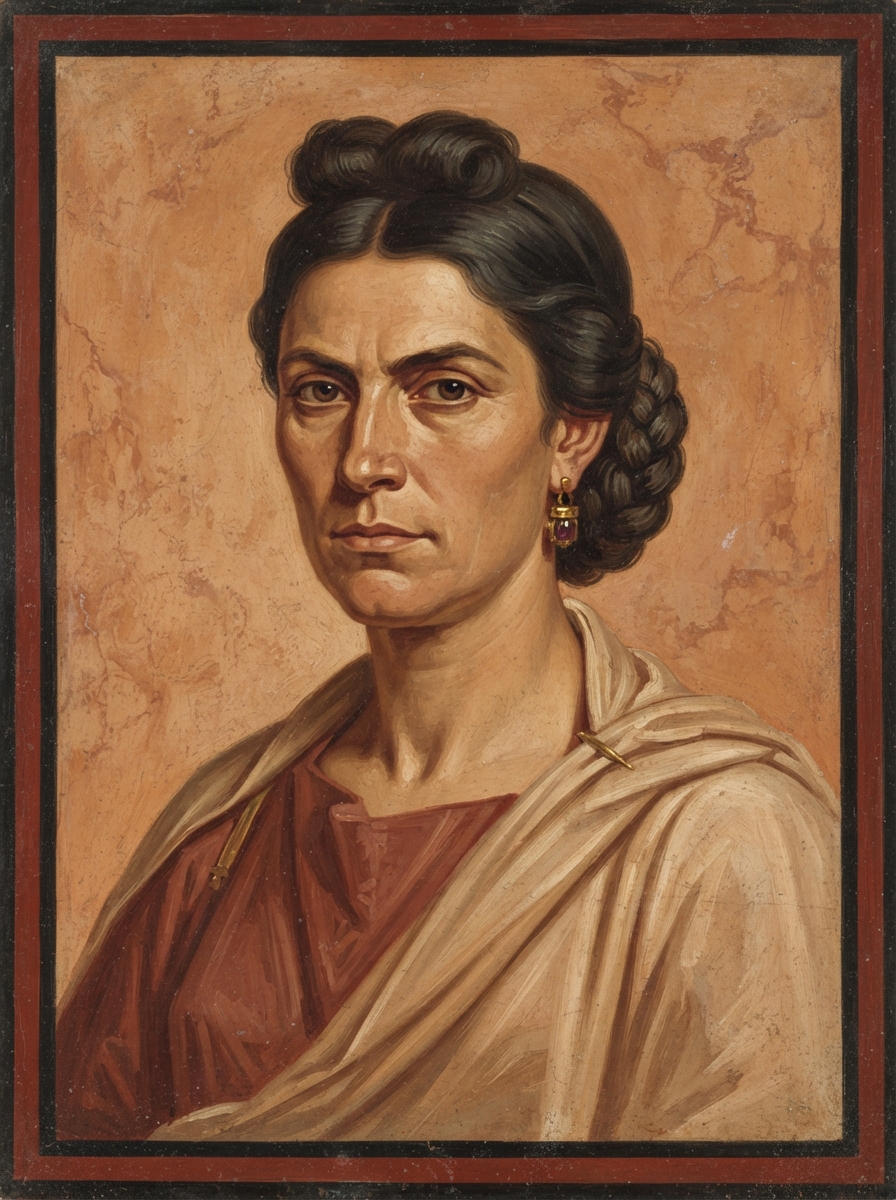
AI-assisted Portrait of Fulvia
The Woman Who Raised an Army
Rome had a well-worn script for the politically ambitious wife: marry well, host the right dinners, whisper into the right ear. Fulvia read the script, understood exactly how much power it withheld, and discarded it. Across three marriages — to the street-brawling tribune Clodius Pulcher, then to Gaius Scribonius Curio, then to Mark Antony — she did not attach herself to power so much as operate it. When Clodius was cut down by Milo's men in 52 BCE, it was Fulvia who had his mangled corpse carried into the Forum and put on public display, a calculated act of theater that lit a mob and burned down the Senate House itself. That was not grief performed for effect. It was grief converted into instrument.
The habit only sharpened with Antony. In the chaos after Caesar's assassination she is credited with actively building the opposition to both Octavian and Cicero, and when Antony had Cicero proscribed and killed, Fulvia reportedly took the severed head in her lap and drove her hairpin through the tongue that had written the Philippics against her family — a final settling of accounts, delivered personally. But the act that has no real precedent in Roman history came in 41–40 BCE, with Antony in the East: Fulvia raised and personally led as many as eight legions into the field against Octavian's forces in the Perusine War, an independent military command undertaken by a Roman woman with no institutional cover and no husband present to authorize it.
Fulvia is ENTJ — dominant Te that did not merely influence Roman politics from the margins but seized its actual levers, commanding legions the way she once commanded a mob.
A General, Not a Patroness — Te — dominant
Other politically formidable Roman women of her era worked through persuasion, dowry, and the careful cultivation of male proxies. Fulvia used those tools too, but she never stopped there. At Perusia she raised legions — recruited, provisioned, and put soldiers into a fortified town under her own authority — and held the field against Octavian's forces for months. That is not influence. That is command, exercised in the most literal and structural sense the Roman world offered: soldiers who answered to her.
The same operational bent shows earlier, in how she ran Antony's domestic political machine while he was consumed by the aftermath of Caesar's murder. She is described organizing the resistance to both Octavian and Cicero directly — not merely favoring a faction from a couch but building one, assembling allies, applying pressure, executing a plan with clear objectives. Fulvia treated the machinery of Roman power as something to be gripped and turned, not admired from its edge.
Even her most notorious acts have the shape of dominant Te logic taken to a ruthless extreme: the Forum display of Clodius's body was not spontaneous rage but a deliberate manipulation of a public system — she understood exactly what a mob does when shown a martyred corpse, and she built the outcome she wanted from that understanding.
Moving Before the Order Arrives — Ni — auxiliary
Antony was in the East when the Perusine War began, occupied with the machinery of the eastern provinces and not directing Fulvia's campaign. She acted anyway, on her own read of where the war was actually heading — that Octavian could not be allowed to consolidate Italy uncontested while Antony's attention was elsewhere, and that the moment to intervene was now, before the position hardened against him. That is a long-range strategic inference made without instruction, not a reaction to an immediate threat in front of her.
It is worth noticing what she was not doing. She was not simply defending Antony's existing property or reacting to an attack on his household — the kind of concrete, present-tense response an SJ temperament produces. She was making a wager on the future shape of Roman power, gambling eight legions on a read of how the post-Caesar settlement would eventually resolve. The wager failed. But the failure was strategic, not tactical — she lost a campaign she had no obligation to fight at all, because her internal model of the political horizon told her it needed fighting.
The same pattern runs through her earlier alliances. Marrying successively into the households of Clodius, Curio, and Antony reads, in retrospect, like a woman continually repositioning herself at the exact center of wherever Roman power was about to move next — not chasing status for its own sake, but tracking the trajectory of the Republic's collapse with unsettling accuracy.
The Hairpin and the Corpse — Se — tertiary
Fulvia's strategic sense was rarely abstract. It found its outlet in bodies, in objects, in physical acts staged for a watching crowd. The display of Clodius's ruined corpse in the Forum was not just a political calculation — it was also a visceral, hands-on use of a real dead man's real wounds to produce a real riot. She did not delegate the staging. She put the body where the mob would see it.
The story of Cicero's severed head, reportedly held in her lap while she drove a hairpin through its tongue, carries the same charge — a settling of scores enacted directly on flesh, not through a decree or a proxy. Whatever the precise historical accuracy of the detail, it survived in the tradition because it fit her: vengeance taken by hand, immediate and physical, aimed at the exact instrument — Cicero's tongue, the source of the Philippics — that had wronged her.
And at Perusia this same tertiary Se surfaces as raw physical nerve: she did not simply fund or authorize a war from a distance. She was present with the legions, in the field, in a way no Roman woman of her class had precedent for. The abstraction of Ni gave her the plan; Se supplied the stomach to execute it in person.
What the Campaign Cost Her — Fi — inferior
What Fulvia does not appear to have managed well is the private, interior accounting of what her campaigns cost the people closest to her — including herself. She fought the Perusine War, by most accounts, partly to secure Antony's position and partly to assert her own, and she seems to have badly misjudged how Antony himself would receive an unauthorized war fought in his name. When he returned from the East, the marriage reportedly cooled; she died in Greece not long after, by some accounts estranged from him over the campaign's failure.
That is the inferior-Fi signature: a formidable capacity to read structures and systems, paired with a much shakier grip on the private emotional ledger — what a spouse actually wants, what a personal bond can absorb before it frays. Fulvia built Antony a war he had not asked for and could not fully embrace when he came home to it.
It is telling, too, that so little survives of Fulvia's interior life relative to the sheer volume of her public acts. The ancient sources — mostly hostile, mostly male — remember the Forum, the legions, the hairpin. They do not remember her grief, or what she felt watching her third marriage collapse under the weight of her own initiative. Whether that silence reflects the sources or the woman, it fits a type whose feeling function sat furthest from the surface.
Why ENTJ Over ESTJ
Why not ESTJ?
An ESTJ operating in Fulvia's position would have worked within precedent — securing Antony's interests through existing institutional channels, marriage alliances, patronage, the established levers a Roman consort already had available. Fulvia instead did something with no real precedent at all: she personally raised and led legions in the field, a structural leap beyond anything the system offered a Roman woman. That is Ni reaching past convention to a possibility no established channel contained, not Se/Si discipline maintaining a system that already worked.
The distinction matters because Fulvia's entire career reads as a series of such leaps — from Forum theater to independent military command — each one exceeding what precedent allowed rather than optimizing within it. An ESTJ tends toward mastery of the existing order; Fulvia kept building orders that had not existed before her.
Connected Figures
Further Reading
- Philippics — Cicerothe invective campaign against Antony and Fulvia that provoked her most notorious act of revenge
- Life of Antony — Plutarchthe fullest ancient portrait of Fulvia's political and marital career
- Writings on Fulvia — Judith Hallettmodern scholarship reassessing Fulvia's independent political and military agency
- SPQR: A History of Ancient Rome — Mary Beardcontext on women's constrained public roles in the late Republic
- The Civil Wars — Appianan ancient account of the Perusine War and Fulvia's command in the field
