 Historical Figure MBTI
#552 · 4-27-26 · The Age of Saladin
Nur ad-Din
Emir of Aleppo and Damascus · Unifier of Muslim Syria · The Austere Preacher of Jihad
1118 — 1174
7 min read
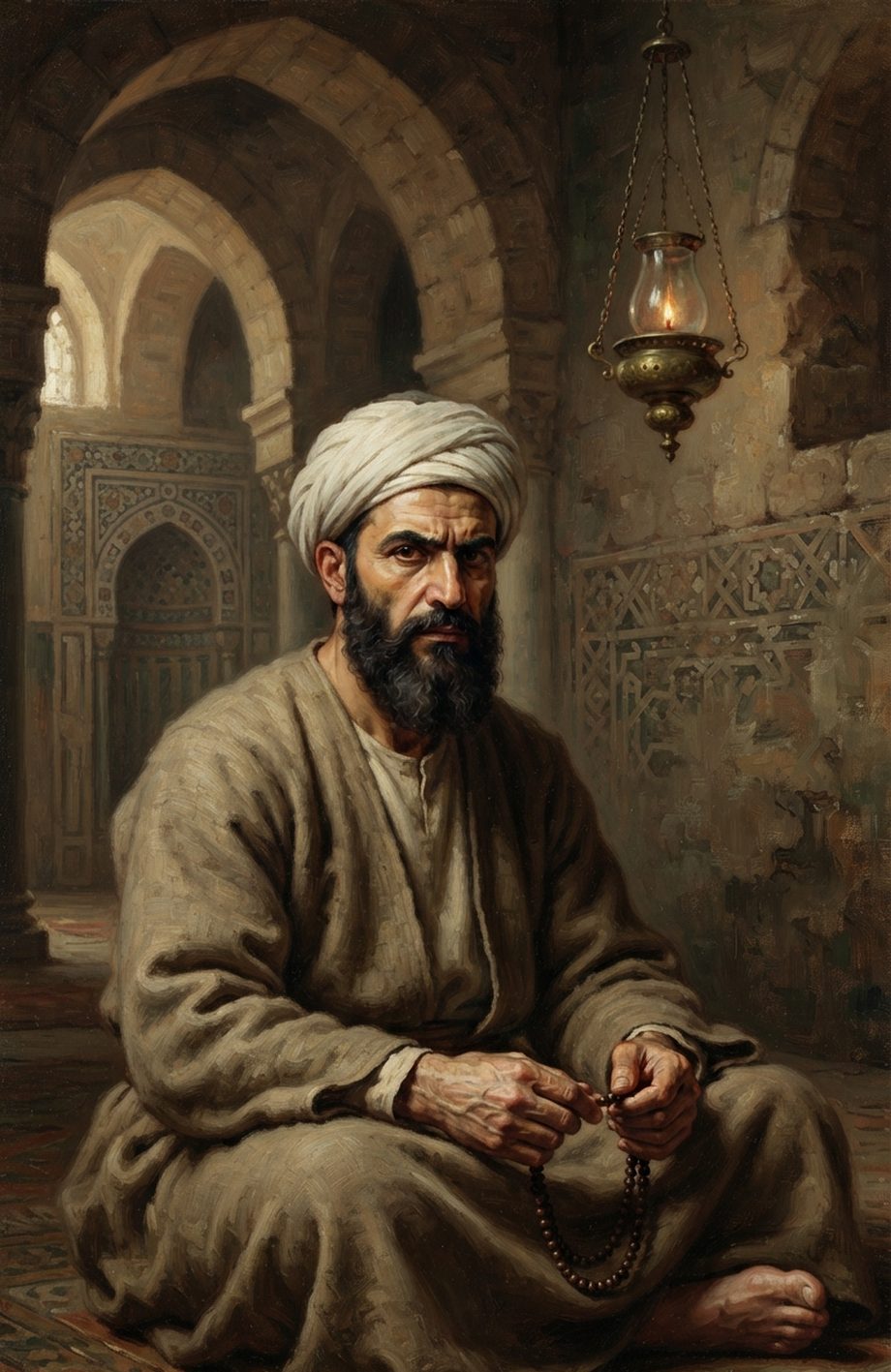
AI-assisted Portrait of Nur ad-Din
The Man Who Forged the Sword Another Would Wield
He wore wool when he could have worn silk, and he ruled from a plain room while his enemies built palaces. Nur ad-Din Mahmud Zangi — son of the fierce Turkish atabeg Zengi — inherited half a war and a fractured Syria, and spent his life doing the least glamorous thing a conqueror can do: he consolidated. Where his father had taken cities by storm, Nur ad-Din bound them together and made them hold. He unified Muslim Syria from Aleppo to Damascus not through the force of a great personality but through discipline, precedent, and the patient construction of institutions that would outlast him.
His contemporaries did not remember him as a charismatic firebrand but as al-Malik al-ʿAdil — the Just King — a ruler so scrupulous that his own justice reached him too. He abolished the non-canonical taxes his treasury depended on, built madrasas, mosques, and the great hospital of Damascus, and took the loose, sentimental idea of holy war and hammered it into a state ideology: disciplined, funded, administered, aimed with cold precision at the recovery of Jerusalem. He is the ISTJ as founder — the unifier who built the machine and let a more magnetic man drive it into legend.
Nur ad-Din is the ISTJ in its most exacting form: a ruler who advanced not by charisma but by Si's austere fidelity to tradition and precedent, paired with Te's tireless administration — unifying a war-state one institution, one tax reform, one madrasa at a time.
The Discipline of the Plain Life
Si — dominant
Dominant Si roots a person in tradition, precedent, and the reliable repetition of what is known to be right — and Nur ad-Din lived it to the bone. His austerity was not a pose but a governing principle. He wore coarse wool, ate simply, and is said to have supported himself from his own private property rather than the treasury, on the reasoning that the treasury belonged to the Muslims and not to him. This is Si morality: the ruler holds himself to the same fixed standard he imposes on everyone else, and never exempts himself because power makes exemption possible.
The same conservatism drove his religious program. Nur ad-Din led a Sunni revival — a deliberate return to orthodox tradition against the Shia currents spreading through Syria and Egypt — founding madrasas, endowing mosques, and surrounding himself with scholars and ascetics rather than courtiers. Where a visionary invents, Nur ad-Din restored something old and made it solid. Even his great cause was a Si cause: the recovery of Jerusalem was not a fresh strategic idea but the reclamation of a sacred inheritance. He had a magnificent wooden minbar — a pulpit — built years in advance, to stand in the al-Aqsa mosque on the day the city was retaken. It sat waiting: the emblem of a mind that fixes on a known, traditional end and methodically assembles every piece the outcome will require.
The Machinery of a War-State
Te — auxiliary
If Si supplied the values, auxiliary Te supplied the apparatus to enforce them. Nur ad-Din was, above all, an administrator of holy war. He did not merely preach jihad; he built the machine that could sustain it — a taxed, garrisoned, chancery-run state stretching from Aleppo to Damascus, and he made the two great cities cohere into a single functioning polity rather than a personal empire that would dissolve at his death. His justice, too, was Te made systematic: he established a house of justice where grievances against even his own officials could be settled by rule rather than favor, abolished the non-canonical taxes unsanctioned by religious law, and endowed the great Nur al-Din bimaristan in Damascus, a teaching hospital that treated the sick without charge for generations. These are the works of a man who trusts institutions over personalities.
And it was Te that turned jihad from a mood into a policy. Nur ad-Din made the reconquest of Jerusalem the declared, organizing purpose of the state — a documented objective toward which taxation, recruitment, and diplomacy were all aligned — and sent his general Shirkuh, with Shirkuh's nephew Saladin, into Egypt to fold its wealth and armies into the same design. He was building a structure large enough that the outcome no longer depended on any single man — not even himself.
The Conscience Behind the Crown
Fi — tertiary
Tertiary Fi gives the ISTJ a private, deeply held moral core that governs the self before it governs anyone else. Nur ad-Din did not lead by force of personality — he led by moral example, addressed first to his own soul. His piety was inward and unperformed: the wool, the fasting, the refusal of luxury were the working out of a conscience that would not let him take what he believed was not his. Where his Te built public courts, his Fi built a private tribunal in which he was the only defendant.
This is what made his austerity persuasive rather than tyrannical. A ruler who imposes hardship from a throne of gold is resented; a ruler who imposes it on himself first is followed. Nur ad-Din's soldiers and scholars believed in the jihad partly because they believed in him — in the visible integrity of a man who asked nothing he did not first demand of his own body and purse. The Fi is quiet and genuine, and it is the reason a withdrawn, unglamorous disciplinarian could hold the loyalty of a fractious age.
Why ISTJ Over ESTJ or INTJ
Why not ESTJ?
The administrator, the justice, the institution-building all sound ESTJ — and the two types share Si and Te. But the ESTJ leads outward: through public command, coalition, and the force of a commanding presence, running the room and the realm from the front. Nur ad-Din did the opposite. He was withdrawn, ascetic, and self-effacing, ruling by moral example and quiet discipline rather than personal magnetism. His Te served an introverted Si core — the machinery existed to protect a fixed tradition, not to project a dominant will. That is dominant-Si inwardness, not dominant-Te command.
Why not INTJ?
He originated the vision of a single united jihad to retake Jerusalem, which can read as Ni strategy. But an INTJ's engine is restless, future-facing imagination that reinvents the problem. Nur ad-Din's was tradition-bound piety and duty — the recovery of a sacred inheritance, pursued by orthodox means. His vision was a thing to be restored, not a system to be reimagined. That is Si fidelity to the remembered and the given, not Ni's hunger for the unprecedented.
The distinction is one of motive. The ESTJ wants to command; the INTJ wants to redesign; Nur ad-Din wanted only to be faithful — to the law, to the tradition, to the sacred task he inherited — and to build the institutions faithful enough to carry that task past his own death. He is the type that measures a life not by how brightly it burned but by what it left standing. And what he left standing was strong enough that a more dazzling man could simply pick it up and win.
Connected Figures
Further Reading
- The Crusades: Islamic Perspectives — Carole HillenbrandThe essential study of the Muslim side of the wars — especially strong on Nur ad-Din's jihad ideology and the Sunni revival he led.
- Nur ad-Din, un grand prince musulman de Syrie au temps des croisades — Nikita ElisséeffThe major scholarly study of the man and his reign — the definitive three-volume account of the unifier of Syria.
- Saladin: The Politics of the Holy War — Malcolm Cameron Lyons & D. E. P. JacksonThe standard modern life of Saladin, indispensable for the fraught relationship between Nur ad-Din and his rising subordinate.
- The Crusader States — Malcolm BarberA clear, authoritative narrative of the Latin East that sets Nur ad-Din's consolidation of Syria in its full strategic context.
