 Historical Figure MBTI
#254 · 3-25-26 · Catherinian Russia
Yemelyan Pugachev
Cossack · Pretender · People's Rebel
1742 — 1775
8 min read
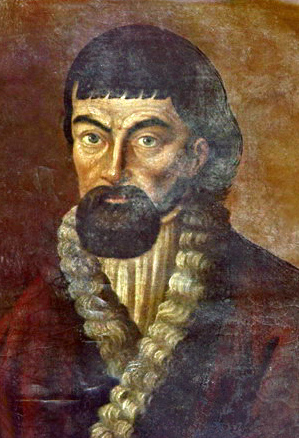
Portrait of Yemelyan Pugachev
The Man Who Decided to Be Emperor
In the autumn of 1773, a Don Cossack—a deserter, an Old Believer, a veteran of Russia's wars against the Turks and Poles—stood before a gathering of Yaik Cossacks on the Volga frontier and announced that he was not Yemelyan Pugachev at all. He was Peter III, the murdered husband of Catherine the Great, miraculously preserved, now returned to reclaim his throne and give his people land, freedom, and an end to conscription and the tax. It was a preposterous claim. He bore no resemblance to the dead tsar, could barely sign his name, and had invented the story within the previous year. Within months, tens of thousands believed it—or chose to—and Pugachev had set fire to the largest popular revolt in the history of imperial Russia.
What makes him psychologically interesting is the speed of his improvisation. He did not plan a rebellion; he discovered one by trying out an idea and watching it catch. The deep Russian folk-myth of the true tsar—the rightful ruler hidden among the people, waiting to return—was lying in the collective imagination, and Pugachev had the audacity to pick it up and wear it. He generated manifestos promising the abolition of serfdom, set up a mock imperial court whose “counts” bore the names of Catherine's real courtiers, besieged Orenburg, stormed Kazan, and for nearly two years kept the entire machinery of the Russian state lunging after a phantom.
The profile that explains him is the ENTP: dominant Ne that seized an impossible possibility and ran with it; auxiliary Ti that understood, with cold tactical clarity, which symbols would convert a crowd; tertiary Fe that let him read desperate men and tell them what they needed to hear; and inferior Si that betrayed itself in his shaky grasp of the imperial details he was forging. Pugachev did not believe he was Peter III. He believed, far more dangerously, that it did not matter whether he was.
Pugachev was the ENTP turned loose on a myth—an improviser who saw that the throne of Russia could be claimed not by blood or by arms but by a story told well enough, fast enough, to a people who wanted to believe it.
The Impostor as Improviser
Ne — dominant
Dominant Ne is the function of the seized possibility—what a situation could become rather than what it is. Pugachev's rebellion was an Ne gamble from the first move. He was not the first man to claim to be the dead Peter III; a Cossack named Fedot Bogmolov had tried the same trick and failed. What separated Pugachev was not the idea but his relationship to it: he treated the imposture not as a fixed lie to be defended but as a live opportunity to be developed. Each small success suggested the next, larger move. Convince a handful of Yaik Cossacks; issue a manifesto; take a fort; besiege a city. Ne does not plan a campaign in advance—it discovers the campaign by following the openings as they appear.
His manifestos were pure Ne: a proliferation of promises calibrated to the audience of the moment. To the serfs he promised land; to the Cossacks, their old liberties; to the Old Believers, freedom of their faith; to the Bashkir and Tatar peasants, their forests and the removal of Russian officials. He was not building a coherent program—he was generating, in real time, a different vision of a freer Russia for every group whose grievance he could turn into manpower. The rebellion swelled because Pugachev could always see one more constituency to convert. Even his mock court was an act of improvisational world-building: he conjured a “War College,” appointed “counts” named after Catherine's genuine ministers, and staged the rituals of a sovereign court he had glimpsed only from the outside. The performance held precisely as long as no one looked too closely—the natural lifespan of an Ne-driven fiction.
The Cold Logic of the Lie
Ti — auxiliary
Auxiliary Ti supplied the calculation that kept the imposture viable far longer than it had any right to last. Pugachev grasped that the Russian peasant's loyalty was structurally available to a tsar but not to a rebel—that a man claiming to be the throne's rightful occupant could turn obedience into a weapon. The decision to be Peter III rather than simply Pugachev the Cossack was not delusion; it was tactics. It transformed a bandit raid into a legitimist restoration and gave every serf who joined him the comforting fiction that he was not betraying his sovereign but serving the true one.
Ti strips a situation to its operative mechanism. Pugachev targeted Orenburg because it controlled the region; he aimed at Yaik fortresses because their guns were exactly what pitchfork-bearing peasants lacked. His manifestos were chosen with the same cold-bloodedness: abolish serfdom, the poll tax, conscription—the three loads under which the Russian peasant actually groaned. The limits of his Ti are equally revealing. He could see the mechanism of legitimacy and the mechanism of grievance, but he could not build supply lines, hold fortified positions, or maintain a chain of command. His “army” had to be improvised again after each defeat. When Catherine turned Alexander Suvorov against him, the gap between an improviser who reasons brilliantly in the moment and a professional who reasons in campaigns became, for Pugachev, fatal.
The Voice the Crowd Wanted to Hear
Fe — tertiary
Tertiary Fe gave Pugachev the demagogue's indispensable gift: the ability to read what a room of frightened, angry, hopeful men wanted to feel, and to become its embodiment. Eyewitness accounts describe a rough charisma, a confident bearing, a knack for the gesture and the phrase that bound men to him. He spoke the language of the Cossack and the serf because it was his own, and he wielded the emotional vocabulary of Orthodox grievance and folk justice with the fluency of a man who had lived inside it.
Tertiary Fe in the ENTP is not warmth; it is social instrumentation. Pugachev staged his imperial court partly as a feeling-machine—a spectacle designed to make peasants experience awe and belonging in the presence of their “tsar.” He distributed titles freely because men given a rank by an emperor will fight to defend him. Yet tertiary Fe is unreliable, and its failure is written into the rebellion's collapse. As defeat followed defeat, the lieutenants he had bound with titles calculated that his head was worth more to Catherine than his cause. His own Cossack officers seized him, bound him, and handed him to the imperial authorities—the precise betrayal that a sovereign backed by genuine fealty would never have suffered.
The Costume He Could Not Inhabit
Si — inferior
Introverted sensing is the function of accumulated, concrete, remembered detail—the mastery of precedent, procedure, and the small factual particulars that make a claim hold up. In the ENTP it sits last, and in Pugachev its weakness was the load-bearing crack in the whole enterprise. He was claiming to be a man whose identity was constituted by exactly such details: the customs of the court, the rituals of the church as performed by a tsar, the feel of having been Peter III. These were the things Pugachev could not know and could only approximate, and the approximations showed.
He could barely read or write; his manifestos had to be drafted by literate aides. His imperial “counts” were named for Catherine's courtiers because rumor was the only source he had. Inferior Si cannot fake the deep texture of lived particulars, and so the imposture worked only at a distance and only on those who needed it to be true. The educated officer, the captured nobleman, the official who had actually seen the court—these were never fooled. The end was a final collision with the concrete reality that Ne can fly over but never abolish. Caged, paraded across the country, and interrogated in Moscow, Pugachev was stripped of myth and crowd and theater; what remained was simply a deserter from the Don. In January 1775 he was beheaded and quartered in a Moscow square.
Why ENTP Over ENTJ
Why not ENTJ?
The ENTJ's dominant Te builds structure: it organizes, fortifies, holds ground, and converts momentum into durable institutions. Pugachev did almost none of this. He won by movement, improvisation, and the contagious spread of a story, and he repeatedly squandered his gains—burning Kazan rather than holding it, raising armies that melted after each defeat. His genius was the seized possibility, not the executed plan. An ENTJ would have wanted a real throne and built toward it; Pugachev kept improvising a fictional one. That is the ENTP under pressure, not the ENTJ.
The deeper tell is his relationship to the lie itself. An ENTJ rebel would most likely have led as himself—asserting a program, governing by organized will. Pugachev wrapped his entire enterprise inside someone else's identity, betting everything on a borrowed myth he could expand or contract as the moment demanded. That is the signature of Ne over Te: fluid, shape-shifting exploitation of a symbolic opening rather than the steady construction of one's own authority. The same instinct that conjured tens of thousands of followers from a rumor left him unable to build anything that could survive contact with Catherine the Great's disciplined state. Pugachev was a comet, not a foundation—the ENTP's gift and curse, written across two years and ending under the executioner's axe.
Connected Figures
Further Reading
- Pugachev's Rebellion — John T. AlexanderThe standard English-language history of the revolt — detailed, scholarly, and indispensable for understanding the political and social context.
- The Captain's Daughter — Alexander PushkinPushkin's historical novel, set during the rebellion, remains the most vivid literary portrait of Pugachev; Pushkin also wrote a separate nonfiction History of Pugachev.
- A History of Russia — Nicholas V. Riasanovsky and Mark D. SteinbergPlaces the Pugachev revolt within the broader sweep of Russian imperial history and the social conditions that made mass rebellion possible.
- Catherine the Great: A Portrait of a Woman — Robert K. MassieCovers the rebellion extensively from Catherine's perspective, showing how the crisis reshaped her domestic policy.
