 Historical Figure MBTI
#382 · 4-4-26 · Tudor England
Edward VI
King of England · The Protestant Boy King · The Last Tudor Son
1537 — 1553
5 min read
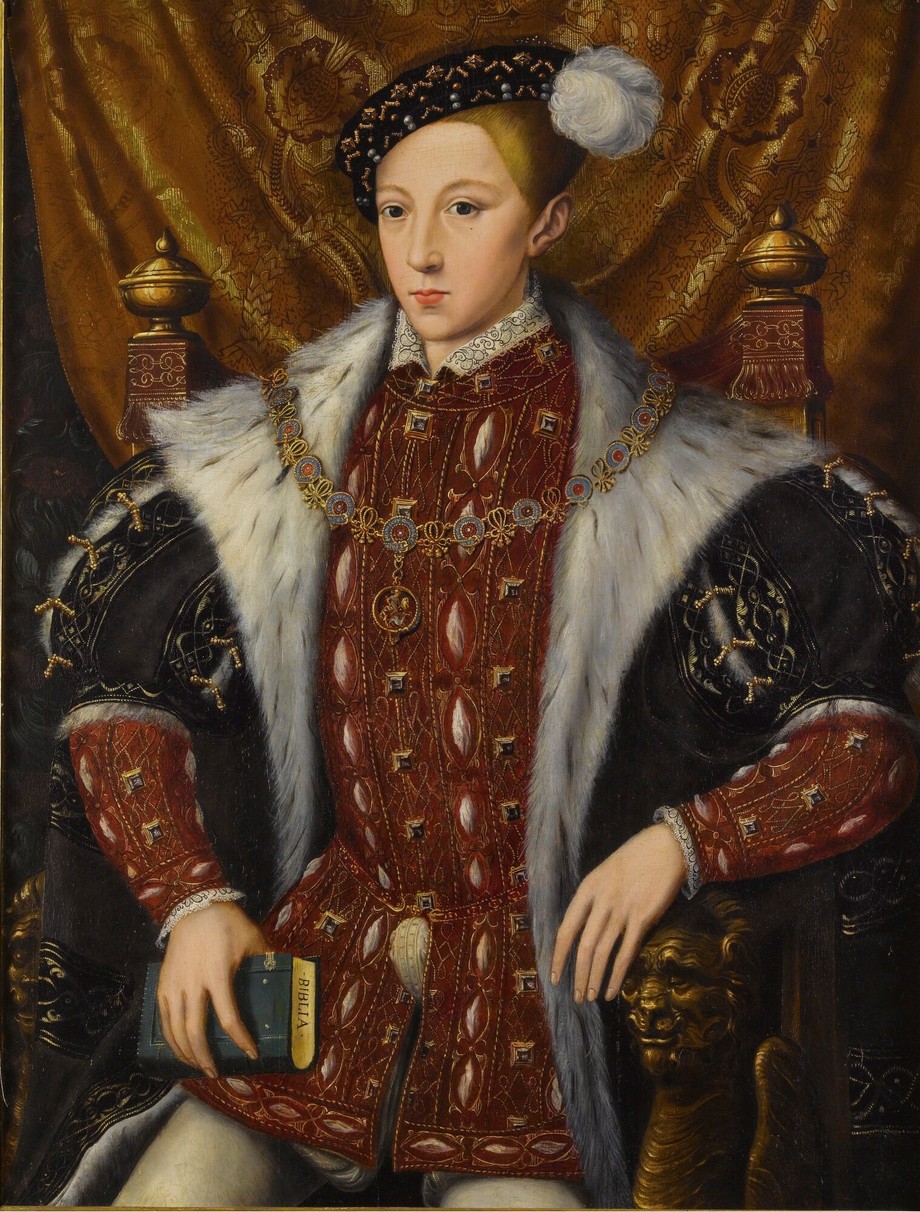
Portrait of Edward VI
The Boy Who Governed by the Ledger
Henry VIII broke with Rome, beheaded two wives, and waited nearly three decades for a legitimate son. In October 1537 he finally got him. Jane Seymour gave the king his heir and died within a fortnight. Edward was hot-housed accordingly: hedged with physicians and from the age of six poured full of Latin, Greek, and a fervent evangelical Protestantism that a precociously capable mind absorbed entire.
What emerged was not a warm child. He kept a private journal—the Chronicle—that still chills four centuries later: executions, rebellions, the deaths of those closest to him, all entered with the same flat calm. When his uncle the Lord Admiral went to the block, Edward noted it in one bloodless sentence. Dying of consumption at fifteen, he made one last exercise of will—the “Devise for the Succession,” which struck his Catholic half-sister Mary from the line and settled the crown on the safely reformed Lady Jane Grey. Doctrine made law by a deathbed clerk. The type is the ISTJ: dominant Si in the rigid order; auxiliary Te in the dutiful cast; tertiary Fi in the unbending conviction; inferior Ne in the cold literalism.
Edward VI was the ISTJ in miniature and under glass—a boy who governed his short life by dominant Si order and auxiliary Te duty, keeping the deaths of his own uncles in a dry private ledger and dying with a rule-bound scheme to bind the succession to doctrine.
The Chronicle in His Own Hand
Si — dominant
No document expresses dominant Si more purely than Edward's Chronicle: a register—dated, sequential, factual—in which the king sets down his government with the care of a man balancing a book. His own uncles are beheaded and entered, each in turn, with a single dry line. That a boy of twelve kept such a record is remarkable; that he kept it so coldly is the signature of Si in a temperament untroubled by imagination.
The same function shows in his religious orthodoxy. Edward did not arrive at his Protestantism by inspiration; he absorbed it as established truth and held to it with unbending fixity. Si does not bend the rule to the person; it holds the person to the rule.
The Clerk-King and His Duty
Te — auxiliary
Edward's mind had an administrative cast even as a child. His papers include memoranda on the reform of the coinage and the realm's finances, written with precocious practical grasp. He approached his royal office as a duty owed—a job with tasks attached, to be performed correctly.
Te surfaced most consequentially at the end. Faced with his Catholic sister inheriting and undoing the reformed settlement, Edward did not pray or despair—he drafted. He produced a legal-administrative instrument that re-engineered the succession by rule, settling the crown where doctrine required. The clerk-king imposing order on the future the only way he knew how. Te builds the system; it does not always foresee whether the world will obey it.
The Unbending Private Conviction
Fi — tertiary
Tertiary Fi in an ISTJ produces a deep, private, inflexible sense of what is right. Edward's Protestantism was not inherited doctrine; it was a conviction held in his bones. When the Council pressed him to grant Mary a dispensation to hear the Mass, he reportedly wept—not from tenderness toward her, but from anguish at tolerating what he held to be idolatry. The boy who noted an uncle's execution without a tremor could be moved to tears by a question of the sacrament.
The deathbed “Devise” is Fi as much as Te. He could not, in conscience, hand the reformed church to a sister who would dismantle it. Characteristic of the type: the feeling expressed itself not in a tender farewell but in a rigid legal instrument.
The Cold Literalism of a Boy
Ne — inferior
Inferior Ne is the ISTJ's blind spot: a weak grip on possibility and imaginative play. The flatness of the Chronicle is partly this—a more intuitive temperament would have wondered at the inner lives behind events; Edward simply recorded them. He could not imagine that a sincere person might in good faith believe what Mary believed. The doctrine was simply true, the Mass simply wrong—no shimmer of possibility in between. Formidable in argument, pitiless in judgment, curiously closed.
The “Devise” bears the same mark. A more intuitive mind might have foreseen how readily the realm would rally to the rightful Tudor heir. Edward foresaw none of it, fixed on the one outcome his principle demanded. Lady Jane Grey paid for it with her life. The boy had drawn the rule with perfect care and could not see past its edges.
Why ISTJ Over ESTJ
Why not ESTJ?
A king who imposes a settlement and re-engineers the succession can tempt an ESTJ read. But the ESTJ leads from the front: extraverted, directive, comfortable marshalling people in a room. Edward was the opposite—cold, inward, bookish, a boy who exercised his will on paper. He kept a private journal where an ESTJ would have issued public orders.
Edward governed through private record and rigid principle. His instrument was always the written rule—the Chronicle, the memoranda, the “Devise”—and his strength was inward conviction, not room-filling authority. That retreat into the ledger is the mark of the ISTJ.
Connected Figures
Further Reading
- Edward VI: The Young King — W. K. JordanThe foundational scholarly biography, tracing the politics and governance of Edward's minority (1547–1549) in exhaustive detail.
- Edward VI: The Threshold of Power — W. K. JordanThe companion second volume covering 1549–1553, including the fall of Somerset, the rise of Northumberland, and the 'Devise for the Succession.'
- The Chronicle and Political Papers of King Edward VI — W. K. Jordan (ed.)A scholarly edition of Edward's own 'Chronicle' — the primary document for understanding his character and the administrative cast of his mind.
- Tudor England — John GuyThe standard one-volume survey of the period; places Edward's reign in the broader arc of the English Reformation and Tudor dynastic politics.
