 Historical Figure MBTI
#994 · 7-22-26 · The Second World War
Dwight Eisenhower
Supreme Commander · Coalition Builder · The Desk Officer Who Won
1890 — 1969
11 min read
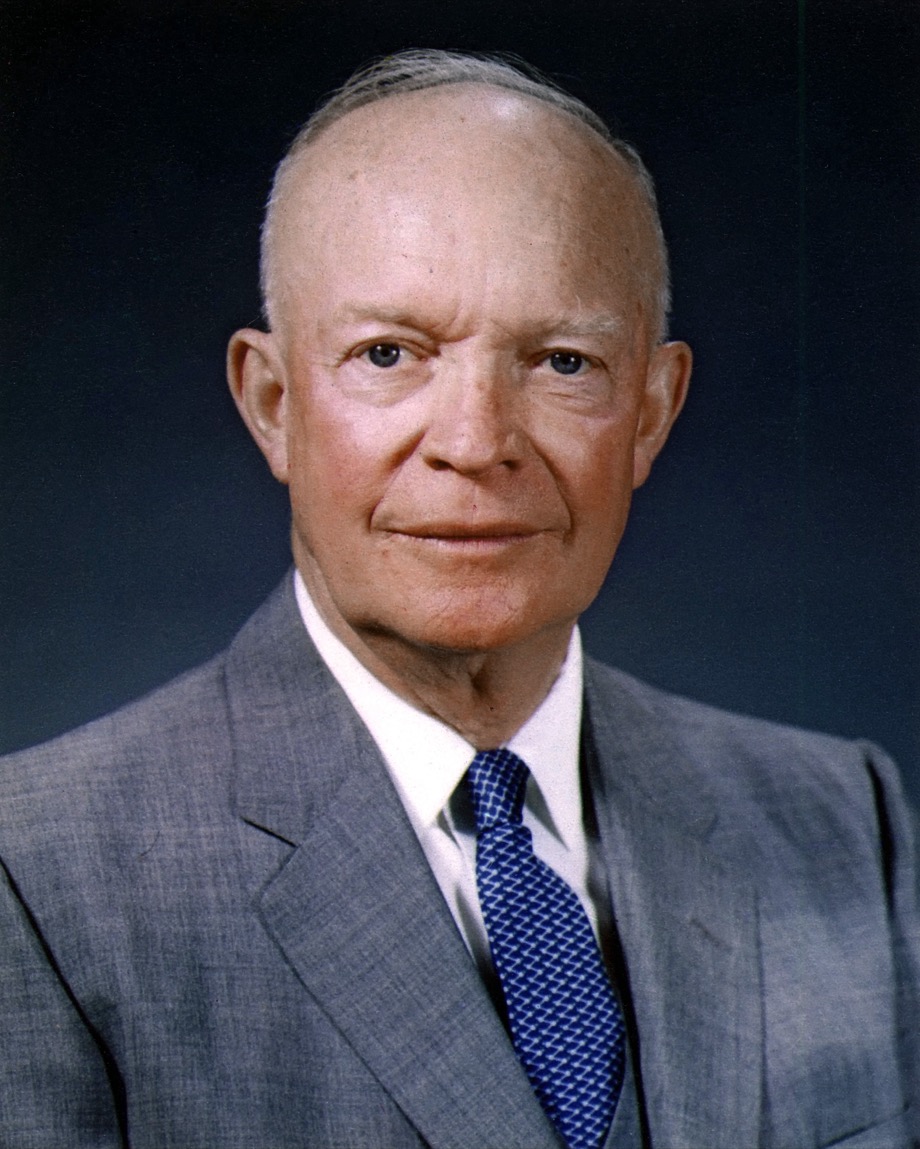
Portrait of Dwight Eisenhower
The Man Who Never Commanded a Division and Commanded Everything
On the morning of 6 June 1944 the largest amphibious operation in human history went ashore in Normandy under the authority of an American officer who had never, in twenty-nine years of service, led troops in combat. Dwight Eisenhower had not commanded a division. He had not commanded a regiment in action, or a company under fire. He had spent the First World War training tank crews in Pennsylvania and had wept about it. The interwar decades he passed as a staff officer — writing manuals, drafting mobilisation plans, ghost-writing for Douglas MacArthur in Manila, filing paper. In 1939 he was a lieutenant colonel. In 1943 he held operational authority over the armed forces of a coalition spanning two continents. Nothing in the conventional theory of military greatness accounts for that ascent.
What accounts for it is that the Second World War in the west was not, at the top, a problem of battlefield genius. It was a problem of assembly: fuel and landing craft and railheads, and the far more volatile matter of holding together men who despised one another. Bernard Montgomery believed the Americans were amateurs. George Patton believed Montgomery was a coward with a press agent. Charles de Gaulle believed France was being liberated by people who intended to govern it. Winston Churchill wanted the Mediterranean; Franklin Roosevelt and George Marshall wanted the Channel. Every one of those quarrels was real, and every one of them had to be absorbed by a single man who could not resolve them by rank alone, because half the people involved did not work for him in any meaningful sense.
Eisenhower absorbed them for three years. He did it not by out-arguing anyone or by unveiling a superior vision, but by knowing the machinery better than anyone else in the room, by remembering exactly what had been promised and by whom, and by grinding forward on a method — the broad front, the steady pressure, the accumulation of unglamorous advantage — that he had reasoned out and then simply refused to abandon. He was, in his own half-joking phrase, the desk officer who happened to win the war. The joke was accurate and the accuracy is the point.
An ISTJ whose dominant Si turned a career of filed paperwork into the deepest working knowledge of the Allied machine any man possessed — and who won by remembering, organising, and enduring what more brilliant men could not be bothered to.
The Archive Between His Ears
Eisenhower’s twenty years of obscurity were not wasted time; they were the accumulation of the material he would later command with. As a young officer he was assigned to write a guidebook to the American battlefields of France — a tedious clerical errand that left him, years later, with an internalised map of the terrain his armies would fight across. Under Fox Conner in Panama he read military history nightly for three years, not for inspiration but as a stocked reference shelf. At the Command and General Staff School he graduated first of 275, a distinction won by mastering detail rather than by originality. None of this looked like preparation for supreme command. All of it was.
Dominant introverted sensing shows itself most clearly in the December 1941 episode that made his career. Summoned to Washington days after Pearl Harbor, he was asked by Marshall what should be done about the Philippines. He asked for a few hours, went away, and came back with a written answer built entirely from remembered particulars: the shipping actually available, the distances, the garrisons, his own years in Manila. The answer was that the Philippines could not be saved and that Australia must be held as the base instead. Marshall kept him. What impressed the Chief of Staff was not vision — it was that Eisenhower knew, concretely, what existed.
That habit governed the war. His grasp of Overlord was a grasp of things: 5,000 vessels, tides and moonlight on a handful of viable dates, the number of divisions that could be supplied through the Normandy beaches before a port fell, the exact tonnage a broken Cherbourg would not deliver. When Montgomery proposed a single narrow thrust to the Ruhr in September 1944, Eisenhower’s objection was not philosophical but arithmetical: he had watched the supply lines stretch from the beaches day by day and knew precisely how far the fuel would reach. He was rarely the cleverest strategist in an argument. He was almost always the man who could remember what the map had actually cost.
Making the Machine Run
Auxiliary extraverted thinking is the faculty that takes an inventory and turns it into a working system, and Eisenhower’s great innovation was structural rather than tactical: the genuinely integrated Allied command. Before him, coalition warfare meant national armies cooperating at arm’s length. At AFHQ and later SHAEF he insisted on mixed staffs in which a British officer might be deputy to an American and orders went out in the name of the headquarters, not the nation. He enforced it ruthlessly at the level of manners. He sent an American colonel home for calling a British counterpart a son of a bitch — not for the insult, he explained, but for the adjective “British.”
He also built the human apparatus that let him function. Walter Bedell Smith existed to be the blade Eisenhower himself preferred not to swing: the chief of staff who delivered refusals, sacked the incompetent, and negotiated the Italian and German surrenders while his commander stayed above the wreckage. Eisenhower gave Smith unusual latitude precisely because he understood organisational division of labour better than he understood self-dramatisation. Under him the theatre ran on standing procedure, delegated authority, and a chain of command that survived the loss of any single personality — including his own.
The broad-front strategy was Te reasoning applied to a continent. Rather than gamble on a single knife-thrust, Eisenhower advanced across the whole line, keeping every army in contact, obliging the Wehrmacht to defend everywhere while American industrial weight told. Critics have called it unimaginative for eighty years, and in a narrow sense it was: it traded elegance for reliability, and it cost lives in the winter fighting of 1944. But it could not be broken by one German counterstroke, and when the Ardennes offensive tore a hole in the line in December, Eisenhower’s response was immediate and administrative — split the command at the bulge, hand the northern shoulder to Montgomery, turn Patton ninety degrees to Bastogne. He reorganised the machine and the machine held.
The Private Ledger of Duty
The famous grin was a working instrument, deployed on request for photographers and troops, and it concealed a man whose actual feeling ran deep, narrow, and inward. The tertiary Fi surfaces in the note he wrote alone on the evening of 5 June 1944, accepting in advance the entire blame for a failure that had not yet happened: the landings had been withdrawn, the troops had done all that bravery could do, and “if any blame or fault attaches to the attempt it is mine alone.” He misdated it and put it in his wallet. No one was meant to see it. It was written for the private ledger in which he kept his own accounts.
The same interior standard explains his handling of Patton. Twice Patton handed him a career to end — the slapping of two hospitalised soldiers in Sicily in August 1943, the loose talk at Knutsford — and twice the correct institutional move was dismissal. Eisenhower instead extracted apologies, humiliated him privately, held him in reserve, and brought him back for the breakout because he judged that Patton’s value to the men who would have to fight outweighed the offence to his own dignity. He did not like Patton in those months. His diary is scathing. He kept him anyway, which is a judgement of duty rather than of affection.
And when his own values were touched, the conciliator vanished. Arriving at Ohrdruf in April 1945 he walked the whole camp, forced himself to look at everything, and then ordered every nearby unit not in the line to be marched through it and every congressman and editor available to be flown in — because, he said, the day would come when someone would claim it was propaganda. That order was not consensus-building. It was a man with an internal moral fact insisting the evidence be made permanent.
The Weather He Could Not Compute
Inferior extraverted intuition is the ISTJ’s pressure point: the branching field of what might happen, which cannot be checked against the archive because it has not happened yet. Eisenhower’s war contained one moment of pure Ne exposure, and everyone who saw him during it described the same man — chain-smoking four packs a day, blood pressure climbing, pacing in the small hours at Southwick House while the June gale blew and Group Captain Stagg offered a thirty-six-hour window that might or might not be real. The data ran out. Only a guess remained. He gave the order at 4:15 on the morning of 5 June, and then had nothing left to do, which was the unbearable part.
The gaps in his generalship follow the same fault line. Where the situation had no precedent to sit on, he was slower and more conventional than the moment wanted. The Falaise gap was left open too long. The Ardennes was thinly held because the intelligence picture matched a remembered pattern of German exhaustion rather than an imagined pattern of German desperation — and he was, to his credit, quicker than his subordinates to recognise the attack as a full offensive rather than a spoiling raid. He rarely improvised brilliance. He never claimed to.
What he possessed instead was a rare tolerance for other people’s intuition. He let Patton run when Patton smelled an opening at Avranches; he authorised Market Garden against his own instincts because he judged Montgomery needed to be given his chance, and he owned the failure afterwards. An ISTJ under-supplied with Ne can either forbid it in others or borrow it. Eisenhower borrowed, and priced the loans carefully.
Why ISTJ Over ENTJ
Why not ENTJ?
The rank invites it: supreme command, five stars, the presidency. But an ENTJ leads by imposing a vision — a Ni-shaped picture of the future that the organisation is then bent to serve — and Eisenhower never had one. He had no signature strategy of his own; the broad front was a conservative synthesis of other men’s proposals, not a personal design, and he arrived at it by weighing what the supply system could actually sustain. His method of controlling the difficult men around him was neither charisma nor domination but patience: hearing Montgomery out for the hundredth time, absorbing de Gaulle’s contempt without retaliating, letting Churchill argue the Mediterranean case until it exhausted itself. An ENTJ commander would have broken those egos or replaced them. Eisenhower managed them, at real cost to his own reputation, because the coalition mattered more than the credit. And the private texture is wrong for ENTJ too — the withdrawn diary, the self-blame note in the wallet, the visible discomfort with acclaim.
Set him beside the ENTJ commanders of his own war and the contrast resolves. Where a Ni-driven general asks what shape the future must take and then wills the organisation toward it, Eisenhower asked what the machine could bear and how to keep every part of it turning together. His subordinates supplied the brilliance — Patton’s kinetic opportunism, Bradley’s operational care, Montgomery’s methodical set-piece battles — and his function was to hold the assembly steady while it worked. That is a Si–Te achievement, and it is the reason the alliance survived Sicily, Anzio, Market Garden, the Ardennes, and the furious politics of the last spring. Brilliance was abundant in 1944. Reliability was scarce.
Connected Figures
Further Reading
- Eisenhower: Soldier and President — Stephen E. AmbroseThe standard single-volume life, strongest on the mechanics of coalition command.
- The Guns at Last Light — Rick AtkinsonNorthwest Europe 1944–45 at ground level; the best account of Eisenhower under strain.
- Eisenhower in War and Peace — Jean Edward SmithA cooler, more sceptical assessment that takes his generalship apart before rebuilding it.
- Crusade in Europe — Dwight D. EisenhowerHis own 1948 memoir — plain, unshowy, and revealing precisely in what it declines to dramatise.
